Tia Kemp Sends a Chilling Warning: Should Rick Ross & T.I “Step Back” Before It’s Too Late?
It started, as these things often do, with noise.
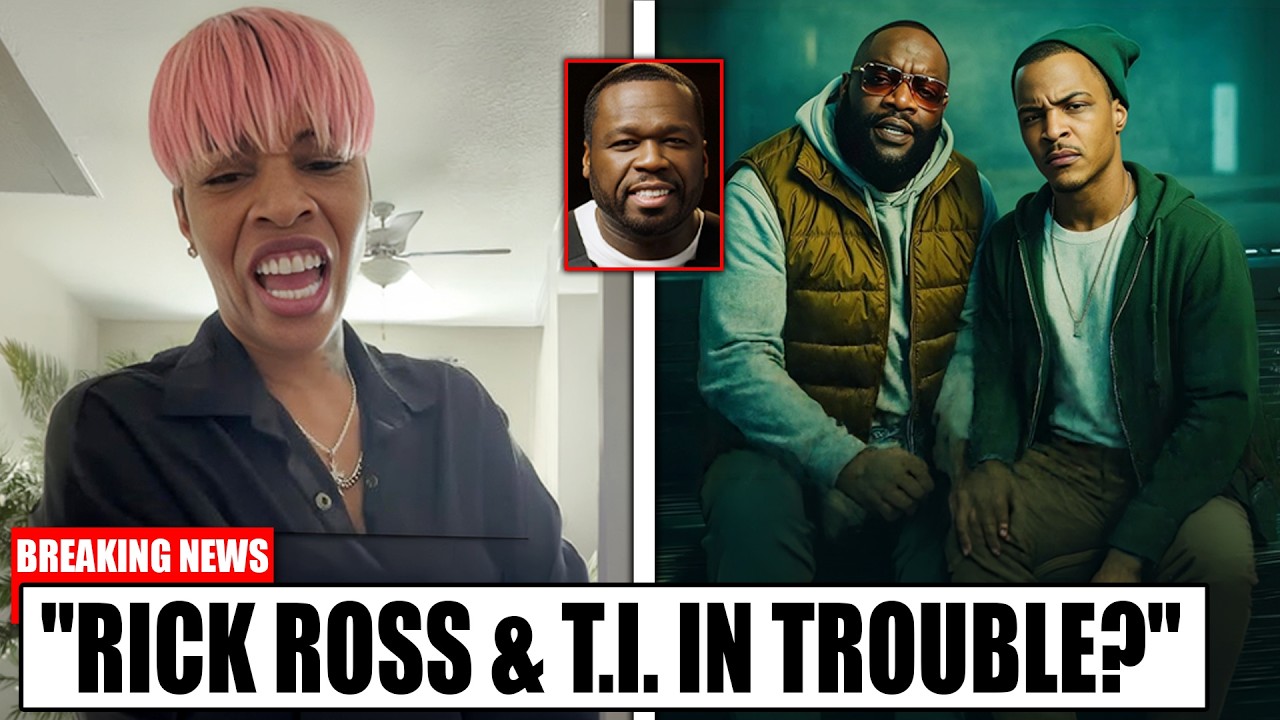
Not music—noise.
Subtle jabs, reposted memes, captions that felt a little too pointed to be accidental.
The familiar tension between Rick Ross and 50 Cent had already been simmering for years, occasionally reheated for public consumption.
Add T.I to the mix—an artist who has never shied away from speaking his mind—and what you have is a volatile triangle that thrives on attention.
But this time, something felt different.
This time, someone suggested the spotlight wasn’t just coming from fans.
When Tia Kemp spoke up, her words didn’t land like gossip.
They landed like a warning.
In a livestream that quickly circulated across social platforms, Kemp implied that the escalating tension aimed at 50 Cent might not be playing out in a vacuum.
She didn’t offer documents.
She didn’t name agents.
She didn’t cite case numbers.
What she did was more subtle—and perhaps more unsettling.
She suggested that federal authorities could be paying attention.
Not to the jokes.
Not to the trolling.
But to the undertones.
The suggestion alone was enough to shift the temperature.
Hip-hop has always existed in a complicated relationship with surveillance.
From the genre’s earliest days, artists have accused authorities of monitoring lyrics, appearances, and affiliations.
But in 2026, in an era of algorithmic tracking and digital receipts, the idea of “being watched” feels less like paranoia and more like procedure.
That context is what made Kemp’s warning resonate.
She wasn’t laughing.
She wasn’t clout-chasing, at least not overtly.
She was calm.

Direct.
Almost clinical.
“Step back,” she implied.
Before it goes too far.
Too far from what? That remains unclear.
For years, 50 Cent has cultivated an image of calculated chaos.
Online, he needles rivals with surgical precision, often goading them into public missteps.
His disputes with Rick Ross have spanned diss tracks, financial taunts, and personal allegations.
The hostility has been performative at times, strategic at others.
Yet beneath the theatrics, there has always been a question: how much of it is business, and how much is personal?
T.I, meanwhile, occupies a different lane.
As a veteran lyricist with a history that includes legal entanglements and subsequent reinvention, he understands the weight of federal scrutiny.
His name entering the conversation—particularly in a context where federal involvement is even hinted—adds complexity.
He has navigated that terrain before.
Whether he wants to revisit it is another matter entirely.
Kemp’s message seemed less about loyalty and more about risk ᴀssessment.
She did not frame 50 Cent as a victim.
Nor did she paint Ross or T.I as villains.
Instead, she introduced a third presence into the narrative: the possibility that the feud itself might be drawing insтιтutional attention.
And in an industry where perception often becomes reality, that suggestion is combustible.
There is no public record, as of now, indicating that any federal investigation is directly tied to the current exchanges between these artists.
No indictments.
No formal statements.
No sealed documents unsealed in dramatic fashion.
But absence of evidence does not erase speculation.
In fact, in the court of public opinion, it fuels it.
Some observers argue that Kemp’s warning could be strategic—an attempt to de-escalate tensions before they spiral into something irreversible.
Others view it as a power move, positioning herself as someone with insight into unseen forces.
Still others believe it may simply be an emotional response to online hostility.
Each interpretation says more about the audience than about Kemp herself.
What cannot be ignored is timing.
The music industry has seen a series of high-profile federal cases in recent years involving artists across genres.
Lyrics have been cited in courtrooms.
Social media posts have been dissected line by line.
ᴀssociations have been mapped out in diagrams presented to juries.
In that climate, even indirect references to federal attention carry weight.
50 Cent, for his part, has built a brand on fearlessness.
He rarely retreats.
He often doubles down.
If Kemp’s warning was intended to intimidate or silence, history suggests that such tactics rarely work on him.
But intimidation may not have been the goal.
The goal may have been prevention.
Rick Ross, known for his larger-than-life persona and strategic silence when necessary, has yet to publicly respond in a way that directly addresses the federal insinuation.
That silence is being interpreted in multiple ways.

Is it indifference? Caution? Legal advice? Or simply a refusal to validate rumors?
T.I has also not leaned into the narrative publicly.
For an artist who has openly discussed past legal challenges, the absence of commentary is noticeable.
He understands, perhaps more than most, how quickly narratives can evolve from entertainment to evidence.
There is also the possibility that this entire episode is a masterclass in modern publicity.
In an age where controversy drives clicks, and clicks drive revenue, the line between genuine conflict and orchestrated spectacle is thin.
A vague warning about federal involvement is guaranteed to generate headlines.
It shifts the conversation from petty rivalry to potential peril.
It reframes the feud as something consequential.
Yet that interpretation ᴀssumes a level of coordination that may not exist.
If there is one constant in hip-hop, it is unpredictability.
Alliances shift.
Enemies collaborate.
Words escalate faster than intentions.
And sometimes, what begins as performance ends in permanence.
Kemp’s phrasing—measured, deliberate—suggested that she believes the stakes are higher than ego.
She did not accuse anyone of crimes.
She did not detail misconduct.
She merely implied that continued targeting of 50 Cent could attract attention that none of them want.
Why 50 Cent specifically? That question lingers.
He is no stranger to legal systems.
He has navigated bankruptcy filings, lawsuits, and public disputes with an almost theatrical resilience.
He also maintains connections across entertainment, business, and media landscapes.
Suggesting that federal authorities might be drawn into a feud involving him adds an extra layer of intrigue.
Is he being protected? Targeted? Or simply too visible to ignore?
There is no confirmation of any of those scenarios.
But ambiguity is powerful.
It invites imagination.
Industry insiders, speaking anonymously, have noted that artists today operate under unprecedented scrutiny.
Every transaction leaves a trace.
Every message can be screensH๏τted.
Every affiliation can be charted.
In that environment, public antagonism can have unintended consequences.
Whether Kemp’s warning reflects inside knowledge or cautious speculation, it aligns with a broader reality: visibility is a double-edged sword.
Fans are divided.
Some dismiss the warning as theatrics, another chapter in a long-running saga designed to keep names trending.
Others express genuine concern, citing recent cases where online bravado preceded serious legal outcomes.
The debate itself keeps the story alive.

Perhaps that is the point.
If the feud continues, and nothing happens, Kemp’s words will fade into the background as another dramatic footnote.
If, however, any legal development emerges in the coming months—unrelated or otherwise—her warning will be replayed endlessly as prophetic.
For now, there are only questions.
Will Rick Ross adjust his approach? Will T.I publicly distance himself from the conflict? Will 50 Cent escalate, mock the insinuation, or ignore it entirely? Each decision will be interpreted not just as entertainment strategy, but as risk management.
The most striking aspect of this episode is not the insult exchanges.
It is the introduction of uncertainty.
When federal involvement is even whispered, bravado tends to soften.
Or at least become more calculated.
In the end, the music industry has seen feuds come and go.
Most burn H๏τ, then fade.
A few leave scars.
What determines the outcome is rarely obvious at the start.
Kemp’s warning may amount to nothing more than a moment of caution amplified by social media.
Or it may represent a turning point—a subtle acknowledgment that the rules have changed.
Until evidence surfaces, the narrative remains suspended between drama and danger.
The artists continue their public lives.
The fans continue to watch.
And somewhere in the background, whether real or imagined, the possibility of unseen observers lingers.
In hip-hop, perception can be as potent as proof.
Right now, perception is doing most of the work.


