“Minutes to Escape: Why Authorities Ordered Sudden Evacuations in Sicily”
Panic spread in minutes as residents in parts of Sicily were ordered to flee under an emergency declaration triggered by sudden ground movement that showed no immediate signs of stopping.
Reports described people evacuating in near chaos—some with only seconds to react—as the land beneath homes and roads began to shift, crack, and slide in a way locals said they had never witnessed before.
What unfolded was not a single dramatic collapse, but something more unsettling: a slow, grinding movement of earth that continued even after evacuations were underway.
Authorities confirmed that dozens of families were forced to leave their homes as a precaution when monitoring systems detected accelerating ground instability.
In some areas, evacuation orders were issued rapidly, giving residents only minutes to move to safety.
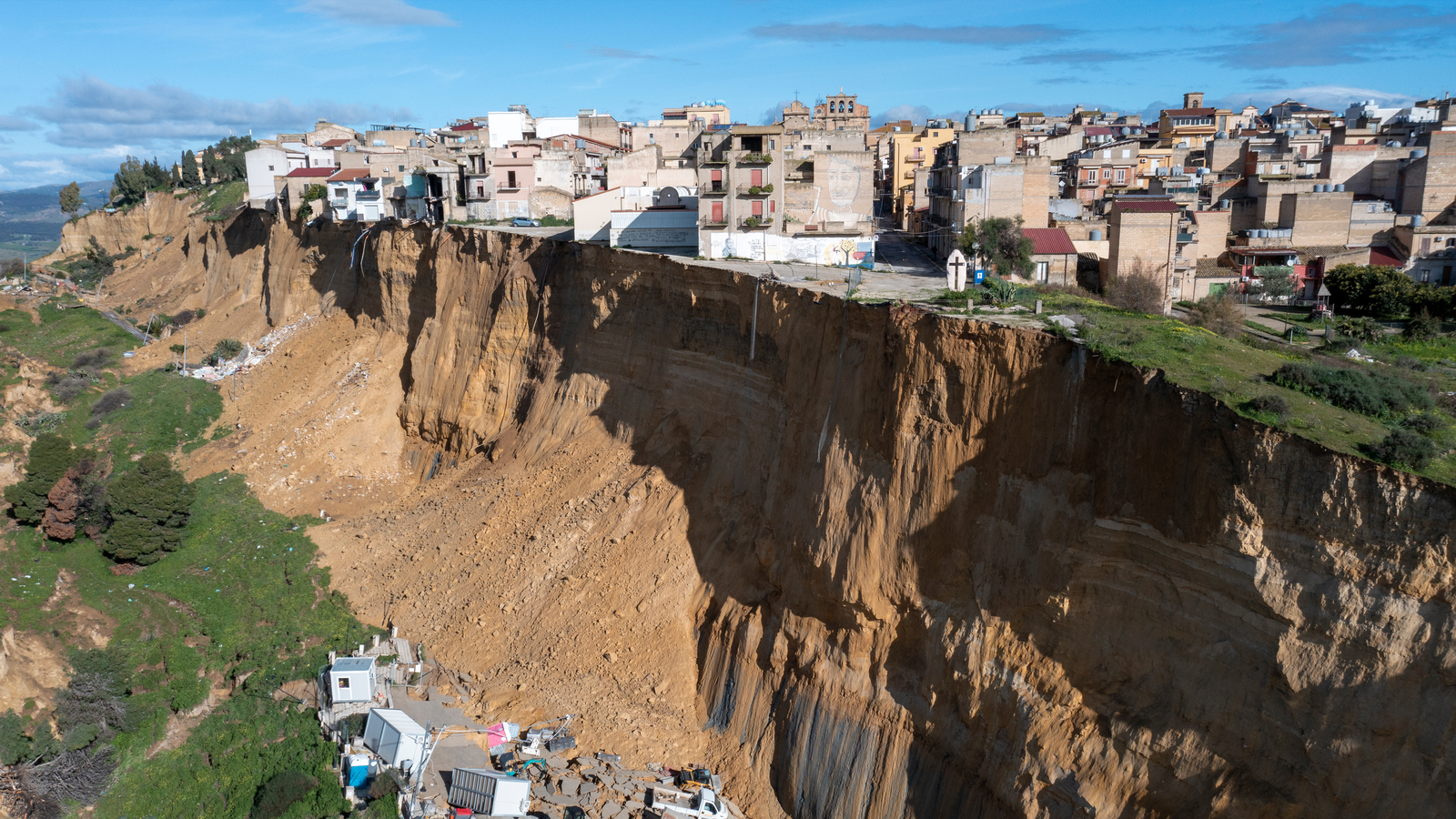
Videos circulating online showed tilted buildings, fractured pavement, and hillsides creeping forward inch by inch—an eerie reminder that disasters do not always strike in one violent moment.
Officials were careful with their language.
This was not a sudden landslide in the traditional sense, but an ongoing mᴀss movement of soil and rock, driven by a combination of geological weakness, water saturation, and terrain stress.
The danger lies not in speed, but in persistence.
When the ground doesn’t stop moving, predicting what will fail next becomes nearly impossible.
Geologists familiar with Sicily’s landscape note that the island is particularly vulnerable to this kind of event.
Sitting along complex tectonic boundaries, with steep slopes and layers of unstable sediment, Sicily has a long history of slow-moving landslides that can suddenly accelerate under the right conditions.
Heavy rainfall, changes in groundwater pressure, or subtle seismic activity can all act as triggers.
What alarmed emergency crews was how quickly conditions changed.
Ground that appeared stable days earlier began shifting within hours, forcing authorities to act before complete ᴀssessments could be made.
Evacuations were ordered not because collapse had already occurred, but because models suggested it could.
Residents described hearing low, continuous sounds—cracking, grinding, and deep vibrations—as the earth moved beneath them.
While dramatic claims online suggested entire towns vanishing, officials emphasized that the real threat was structural failure: homes becoming uninhabitable, roads severed, and utilities compromised as the ground continued to deform.
The phrase “won’t stop” began circulating because the movement did not cease after the initial evacuation.

Monitoring data showed continued displacement, raising concerns that the affected zone could expand.
Once a slope enters this state, stabilization becomes extremely difficult without major intervention—and sometimes, intervention isn’t possible at all until the movement naturally slows.
Emergency responders worked under intense pressure, balancing the need to calm residents with the reality that the situation remained fluid.
Shelters were opened, access roads were closed, and geotechnical teams were deployed to ᴀssess whether further evacuations might be necessary.
Experts warn that these events are often misunderstood by the public.
A slow-moving landslide can be more destructive than a sudden one because it undermines foundations over time.
Buildings may not collapse immediately, but they can become unsafe without obvious warning signs.
This is why authorities often act decisively—even when the visuals don’t yet match the fear.
The larger concern now is what comes next.

If rainfall continues or underground water levels rise further, movement could accelerate.
If it slows, damage ᴀssessments may still reveal entire neighborhoods that can no longer be safely occupied.
Either outcome carries long-term consequences for displaced families.
Officials have urged the public to avoid speculation and rely on verified updates, noting that exaggerated claims can interfere with emergency response.
Still, they acknowledge the fear is real.
Being told to leave your home because the ground itself is moving is a uniquely terrifying experience—one that leaves no clear enemy to fight or escape from.
Sicily’s emergency is a reminder that some disasters don’t explode—they creep.
They grind forward relentlessly, forcing people to run not from what they see, but from what might happen next.
And until the ground finally settles, uncertainty remains the most dangerous element of all.


