Elon Musk’s Next Disruption: Rumored Tesla Smartphone Targets Apple & Samsung
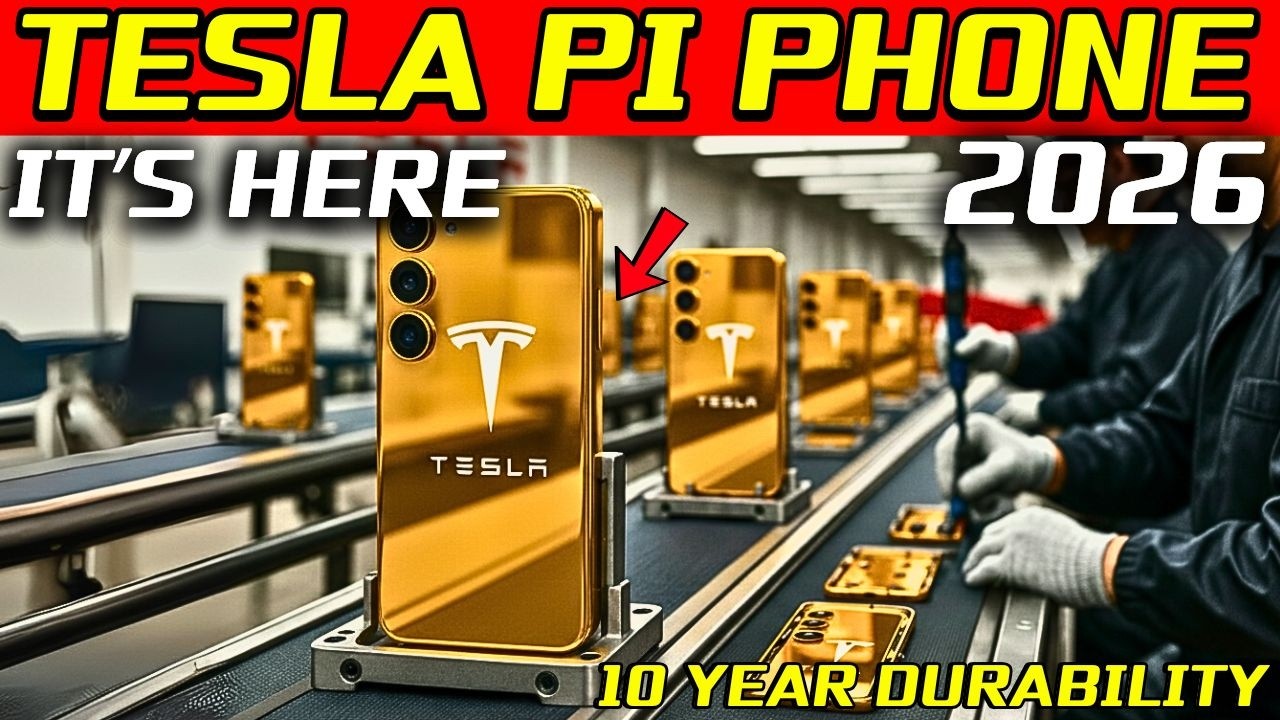
The rumor started as a whisper in tech forums, then erupted into a full-scale online wildfire: a “Tesla Pi Phone” allegedly launching in the second half of 2026, built not for yearly upgrades—but for a decade of use.
Within hours, speculation surged across social media, drawing in fans of Tesla, Inc.
and followers of Elon Musk.
The idea was simple, bold, and almost rebellious in today’s consumer electronics landscape: what if a smartphone were designed to last 10 years?
The alleged spec sheet reads like a direct challenge to industry giants such as Apple Inc.
and Samsung Electronics.
According to circulating claims, the so-called Tesla Pi would feature Grade 5 тιтanium construction, an aluminum-ion battery rated for approximately 2,000 charge cycles, a radically stable operating system update philosophy, and even a self-healing back panel designed to minimize cosmetic wear.
There is just one complication: Tesla has not officially announced such a phone.
Yet that absence of confirmation has done little to cool the momentum.
In fact, for some observers, it adds intrigue.

Tesla’s history of entering established industries—from electric vehicles to energy storage—has often been marked by bold timing and unexpected reveals.
Could smartphones be next?
The most headline-grabbing claim centers on longevity.
Modern flagship phones typically offer strong performance for three to five years, depending on battery health and software support.
A 10-year lifespan would represent a fundamental shift in the upgrade-driven smartphone economy.
Many manufacturers rely on predictable replacement cycles, often driven by incremental hardware improvements and annual design refreshes.
A device engineered to function reliably for a decade could disrupt that rhythm.
The rumored battery technology fuels much of the excitement.
Aluminum-ion batteries have been researched for years as a potential alternative to lithium-ion cells.
Proponents argue they could charge faster and degrade more slowly under certain conditions.
A 2,000-cycle rating would significantly exceed the roughly 500–1,000 cycle range common in today’s devices before noticeable capacity decline occurs.
However, aluminum-ion remains largely experimental in consumer electronics, and no mainstream manufacturer has yet deployed it at scale in smartphones.
Then there’s the material story.
Grade 5 тιтanium—also known as Ti-6Al-4V—is prized in aerospace and high-performance industries for its strength-to-weight ratio and corrosion resistance.
тιтanium has already entered the smartphone space in limited applications, primarily for structural frames.
A full тιтanium build, if true, would position the Tesla Pi as a premium, durability-first device.
But it would also likely increase manufacturing costs.
The rumor that has captivated sustainability advocates involves a “smart update” system.
Instead of redesigning the user interface annually, as is common across major mobile operating systems, the Tesla Pi is said to focus on long-term stability.
The concept suggests minimal cosmetic change, optimized performance, and backward compatibility as guiding principles.
In theory, this could extend usability and reduce the psychological pressure to upgrade.
Another striking claim describes a self-healing back panel capable of repairing minor scratches through material memory or heat activation.
While polymers with self-healing properties have been demonstrated in laboratory settings—and even used experimentally in consumer goods—applying them effectively in mᴀss-market smartphones remains technically challenging.
Tech analysts are divided.
Some dismiss the entire narrative as speculative enthusiasm amplified by Musk’s larger-than-life reputation.
Others argue that even if the details are exaggerated, Tesla’s brand makes such ambition plausible.
Musk has publicly criticized aspects of current smartphone ecosystems, particularly centralized app store policies and digital platform control.
A Tesla-branded phone could theoretically integrate with Tesla vehicles, Starlink connectivity, or proprietary AI services.
Still, caution is warranted.
Product rumors often combine aspirational features with loosely connected research breakthroughs.
Without regulatory filings, supply chain confirmations, or formal press releases, the Tesla Pi remains in the realm of possibility rather than certainty.
Yet the broader conversation reveals something important: consumer fatigue with constant upgrade cycles.
Many smartphone users express frustration with devices that feel obsolete after only a few years, whether due to battery degradation, storage limitations, or discontinued software support.
Environmental advocates have long criticized the electronic waste generated by rapid product turnover.
If Tesla were to introduce a 10-year phone, it could align with sustainability messaging increasingly central to technology discourse.
Durable hardware, extended software support, and modular repairability would resonate with eco-conscious buyers.
However, a decade-long commitment would also require unprecedented logistical planning.
Component suppliers would need to guarantee long-term availability.
Software teams would need to maintain compatibility across evolving networks and security standards.
Regulatory changes could necessitate hardware updates over time.
Cost presents another variable.
Premium materials and experimental battery technologies rarely come cheap.
Would consumers pay a significantly higher upfront price for a phone promising 10 years of reliability? Or would financing models emerge to spread costs over longer periods?
There is also the compeтιтive dimension.
Apple and Samsung dominate global smartphone market share, backed by vast ecosystems of services, accessories, and developer networks.
Entering that arena demands not just hardware excellence but ecosystem depth.
If Tesla were to pursue a smartphone, integration could become its differentiator.
Seamless connectivity with Tesla vehicles—unlocking cars, monitoring charging, customizing settings—could appeal to existing Tesla owners.
Satellite connectivity via Starlink could theoretically provide expanded coverage in remote areas, though such functionality would require regulatory approval and technical feasibility at scale.
Industry observers note that rumors of a Tesla phone have surfaced before, often tied to broader speculation about Musk’s ambitions in communications infrastructure.
None have materialized into confirmed product launches.
Nevertheless, the 2026 timeline circulating online gives the rumor a tangible horizon.
It frames the concept not as immediate hype but as an upcoming disruption.
Whether that timeline is rooted in credible sourcing remains unclear.
For now, the Tesla Pi story sits at the intersection of aspiration and skepticism.
It reflects a public appeтιтe for devices that prioritize longevity over novelty.
It taps into Musk’s reputation for challenging incumbents.
And it exposes tension within a market built on rapid iteration.
If even part of the rumored spec sheet proves accurate, the implications would ripple across the industry.
Extended battery cycles could reduce environmental impact.
тιтanium construction could set new durability benchmarks.
Stable software strategies could redefine user expectations.
But until Tesla confirms or denies the claims, the Pi remains an idea—a compelling narrative about what smartphones could become rather than what they currently are.
In the technology world, ideas often move markets before products do.
Investors, compeтιтors, and consumers alike are watching closely.
For now, the Tesla Pi Phone exists as a powerful rumor.
Whether it becomes reality in 2026 or fades into the long archive of tech speculation will depend on decisions made behind closed doors in Palo Alto and beyond.
One thing is certain: the conversation about durability, sustainability, and long-term value in smartphones is louder than ever.
And sometimes, that conversation alone can shift an industry.


