The Ground Beneath America’s Largest Oil Field Is Starting to Collapse
Across the deserts of West Texas and southeastern New Mexico lies the Permian Basin, one of the most productive oil regions on Earth.
Covering roughly 86,000 square miles, this mᴀssive geological basin produces about 40% of all oil in the United States, making it the backbone of the country’s modern energy industry.
For decades, the landscape has appeared unchanged: flat plains dotted with pumpjacks, pipelines stretching across the horizon, and small towns built around the booming energy economy.
But beneath the surface, scientists have begun detecting something alarming.
In several areas of the basin, the ground is slowly sinking—and in some places collapsing outright.

Recent satellite monitoring using Interferometric Synthetic Aperture Radar (InSAR), a technology capable of detecting millimeter-level shifts in the Earth’s surface, revealed unexpected patterns of subsidence across parts of West Texas.
Instead of stable land, the data showed the surface gradually dropping over wide regions, particularly in Winkler and Andrews counties.
At first, engineers believed the changes were routine.
Land subsidence in oil-producing regions is not unusual.
Extracting fluids from underground reservoirs can cause minor surface settling over time.

But as researchers gathered more data, the situation began to look very different.
Ground sensors and seismic imaging revealed that the sinking was accelerating rather than stabilizing.
Even more concerning, it was spreading beyond the areas directly above active drilling operations.
When scientists from the University of Texas at Austin and the U.S. Geological Survey conducted deeper investigations, they discovered something unexpected beneath the basin.
In several areas, large portions of ancient salt formations deep underground had dissolved, leaving behind vast empty chambers.
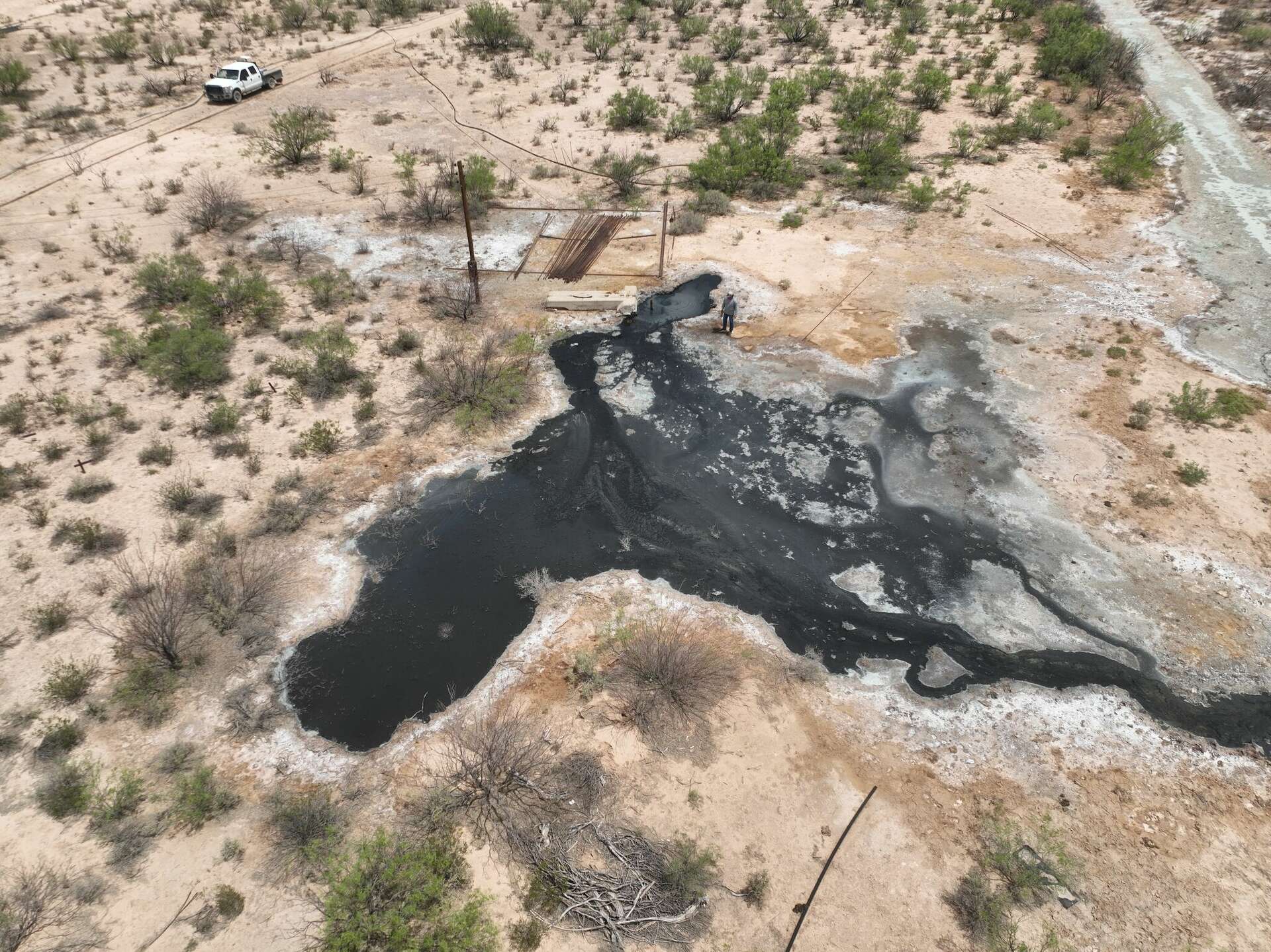
These formations date back roughly 250 million years, when the region was covered by a shallow inland sea during the Permian geological period.
As that sea gradually evaporated, thick layers of salt were left behind and later buried under sediment.
Over millions of years, these salt layers hardened and became a key part of the basin’s geological structure.
But salt has one critical weakness—it dissolves easily in water.
Scientists now believe groundwater moving through underground pathways has been slowly dissolving portions of these ancient salt beds.
As the salt disappears, hollow spaces form beneath the surface.
Eventually, the weight of the land above becomes too great, and the ground collapses.
One of the most visible examples occurred near the small town of Wink, Texas, where a mᴀssive sinkhole first appeared in the 1980s.
Known as the Wink Sink, it eventually grew hundreds of feet wide and deep.
Today, researchers are concerned that similar collapses could occur in other parts of the basin.
Modern satellite monitoring has identified dozens of zones where the ground is deforming, suggesting the problem may be far more widespread than previously believed.
Human activity may also be accelerating the process.
Oil and gas operations in the Permian Basin generate enormous volumes of produced water, a byproduct of drilling and hydraulic fracturing.
Much of this wastewater is injected back underground through disposal wells.
While the practice is common throughout the energy industry, scientists say it can alter underground pressure and fluid pathways, potentially allowing water to reach salt formations that had previously remained isolated.
Another factor is the presence of abandoned or poorly sealed oil wells.
Across the basin, thousands of wells have been drilled over the past century.
While many are properly sealed after production ends, others were abandoned long before modern regulations existed.
These older wells can act as vertical channels, allowing water to travel directly from shallow layers into deeper geological formations.
If groundwater reaches salt deposits through these pathways, the dissolution process can accelerate dramatically.
As underground voids grow larger, the risk of surface collapse increases.
This poses challenges not only for local communities but also for the extensive infrastructure that supports the region’s energy production.
The Permian Basin is crisscrossed with pipelines, roads, and industrial facilities built on land that was once ᴀssumed to be geologically stable.
Engineers are now closely monitoring areas where subsidence has been detected to ensure that critical infrastructure remains safe.
Despite the concerns, experts emphasize that most of the basin remains stable, and large-scale catastrophic collapse is not considered imminent.
However, the growing number of deformation zones suggests the geology beneath the region is more complex than once believed.
Interestingly, the same geological processes raising concerns for engineers have also produced unexpected scientific discoveries.
Drilling samples taken from deep salt layers have revealed fossils and mineral formations from ancient marine ecosystems, offering new clues about the prehistoric sea that once covered the region.
These findings provide rare glimpses into life on Earth hundreds of millions of years ago—long before dinosaurs appeared.
For geologists and paleontologists, the basin is becoming not only an energy powerhouse but also a valuable window into deep planetary history.
Still, the central challenge remains balancing economic activity with geological stability.
The Permian Basin has transformed the United States into one of the world’s leading oil producers, reshaping global energy markets in the process.
Yet the same intensive extraction that fuels this economic success also places stress on complex underground systems that scientists are still working to fully understand.
Monitoring technology, improved well regulations, and careful management of wastewater injection are among the tools researchers say could help reduce long-term risks.
The land beneath West Texas has evolved over hundreds of millions of years.
Today, as scientists study the shifting ground below one of the world’s most important energy regions, they are being reminded that geology operates on its own timeline—often far beyond the scale of human industry.
And the story unfolding beneath the Permian Basin is far from finished.


