After Jesus died, Mary seemed to vanish from the pages of the Bible.
The Gospels, so careful to record her presence at the Annunciation, at Bethlehem, and at the foot of the Cross, suddenly fall silent.
For many Christians, this silence has created the impression that Mary simply faded into obscurity, her role completed once her son’s earthly mission ended.
But history tells a very different story.
Mary did not disappear.
She stepped into a life that would shape Christianity in ways few people ever learn about.

On the hill of Golgotha, Mary watched her son die.
She did not flee like most of the disciples.
She stood close enough to hear his labored breath, close enough to receive his final words.
When Jesus entrusted her to the beloved disciple, he was not merely ensuring her physical care.
In that moment, a new kind of family was created, one rooted not in blood but in faith.
Mary became part of the earliest Christian household, living within the heart of the newborn Church.
After the resurrection, Mary reappears briefly in the Book of Acts.

She is there in Jerusalem, praying with the apostles as they wait for the coming of the Holy Spirit.
This single verse places her at Pentecost, at the very birth of the Church.
She witnessed the transformation of frightened disciples into fearless witnesses.
She heard Peter preach.
She watched thousands join the movement her son had begun.
Then, just as suddenly, Scripture goes silent again.

That silence, however, did not stop memory.
Early Christian communities preserved stories of Mary’s later life, pᴀssed down orally long before they were written.
According to ancient traditions, Mary lived for years in prayer and contemplation, quietly supporting the growing Church.
Some accounts place her in Jerusalem until the end of her life.
Others claim she traveled with the Apostle John to Ephesus, far from Judea, where Christianity was spreading into the Gentile world.
Both traditions were held as sacred by early believers, and both were fiercely defended.
Beyond her daily life, the most striking traditions concern Mary’s death.
Early Christians did not speak of her dying in fear or suffering.
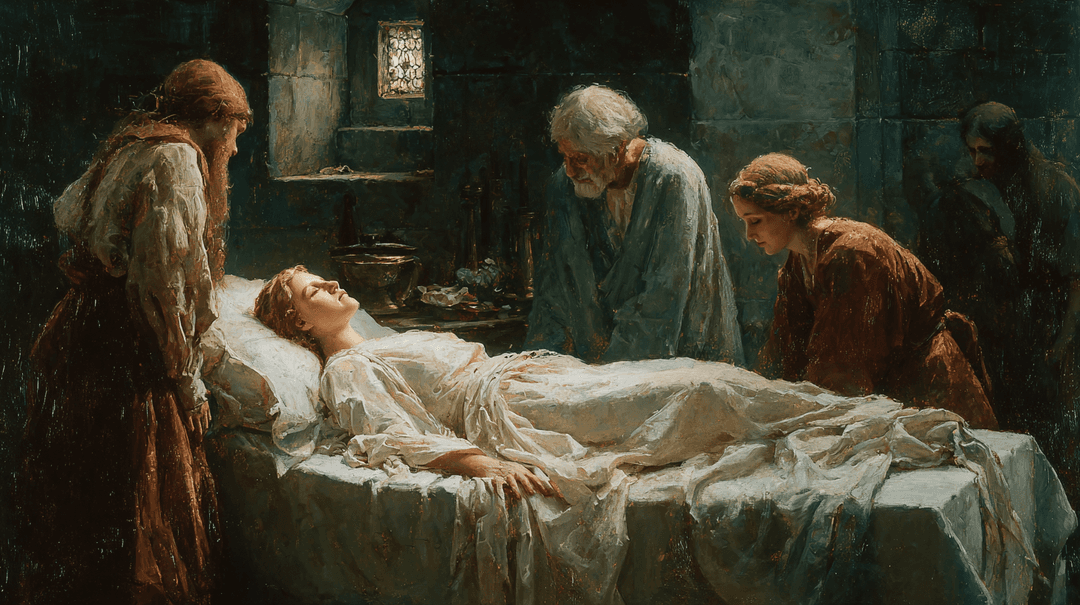
Instead, they described her “Dormition,” her falling asleep.
According to these accounts, Mary knew her end was near and welcomed it peacefully, confident in the resurrection she had already seen with her own eyes.
The apostles, miraculously gathered, prayed beside her as she pᴀssed from this world.
What happened next became one of Christianity’s most enduring mysteries.
When Mary’s tomb was later opened, it was empty.
Her body, according to tradition, had not remained in the grave.
Just as Christ rose from death, Mary was believed to have been taken body and soul into heaven.

This belief spread rapidly across the Christian world, long before it was ever formally defined.
Pilgrims visited her empty tomb in Jerusalem.
Hymns were written.
Feast days were established.
The conviction took hold that Mary had been spared corruption and now shared fully in her son’s victory over death.
As Christianity expanded, devotion to Mary grew beyond anything the earliest believers could have imagined.
In the Eastern Roman Empire, she became protector of cities, especially Constantinople.
Emperors carried her icons into battle.
Citizens prayed to her during sieges.
When the city survived impossible threats, they credited her intercession.
She was no longer only the mother who suffered at the cross.
She was the guardian of nations.
Across Europe, ancient icons of Mary appeared, many of them darkened, known today as Black Madonnas.
Whether darkened by age, smoke, or intention, these images captivated generations.
People believed they healed the sick, protected the poor, and stood with the forgotten.
Mary became a figure who crossed cultural and racial boundaries, appearing not as distant royalty but as someone who belonged to everyone.
At the same time, suppressed texts painted a radically different portrait of Mary’s role.
Writings discovered centuries later, such as those found at Nag Hammadi, reveal early Christian groups that saw Mary as a teacher, a bearer of secret wisdom, even a spiritual authority who rivaled male disciples.
These texts were condemned and buried as heretical, but they reveal how contested Mary’s legacy truly was in the early centuries.
Over time, theology continued to elevate her.
Mary was called the new Eve, the one whose obedience undid ancient disobedience.
She was proclaimed Theotokos, Mother of God, at the Council of Ephesus.
Centuries later, doctrines such as the Immaculate Conception and the ᴀssumption were defined, formalizing beliefs that ordinary Christians had held for generations.
What began as a quiet woman from Nazareth became Queen of Heaven in the language of devotion.
Yet beneath all the тιтles and doctrines remains a simple human story.
Mary lived through unimaginable loss.
She buried a son who was also her God.
She watched a movement grow that would change the world, knowing its cost would be blood.
She lived in the tension between grief and hope, memory and mystery.
That may be why devotion to her has endured.
She represents faith that survives silence, suffering that does not collapse into despair, and love that remains when everything else is stripped away.
The Bible does not tell us everything about Mary’s life after Calvary.
But history, tradition, and devotion reveal that she never vanished.
She became something larger than history alone could contain.
And perhaps that is why her story still unsettles, inspires, and divides believers today.
The silence after the Cross was not an ending.
It was the beginning of a legacy that refuses to fade.


