For more than four centuries, a single linen cloth has rested inside the Cathedral of Turin, sealed behind protective glᴀss and preserved under controlled conditions.
Quietly guarded and rarely displayed, it has become one of the most examined and debated objects in human history.
Known worldwide as the Shroud of Turin, this ancient fabric has challenged historians, theologians, and scientists across generations.
Time has worn its fibers, fire has scarred its surface, and controversy has followed it relentlessly.
Yet its influence has never faded.
The Shroud is a rectangular linen cloth measuring approximately four point four meters in length and just over one meter in width.
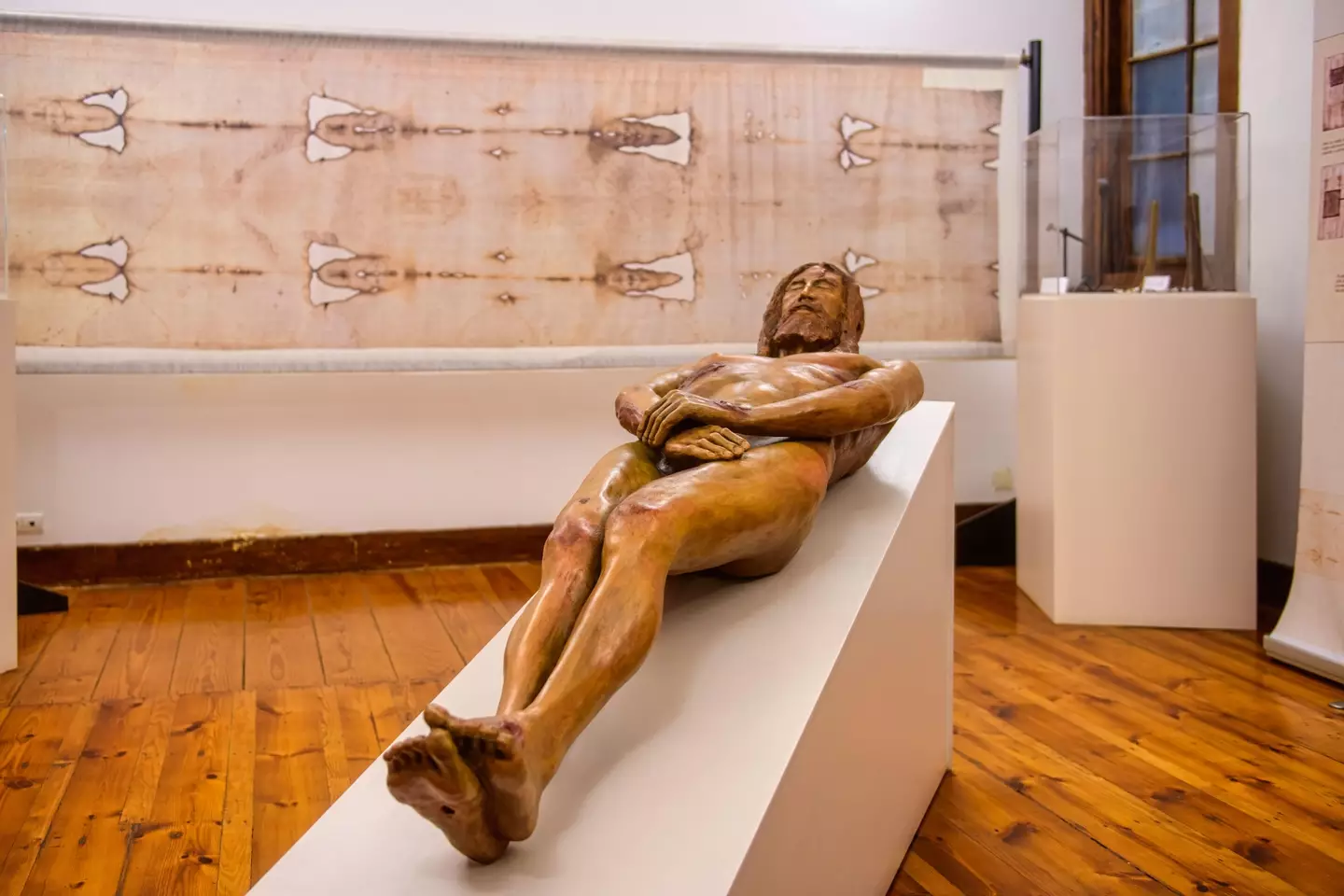
Faint yet unmistakable markings appear on its surface, forming the image of a man who shows signs consistent with Roman era crucifixion.
The figure appears both front and back, as if the body had been wrapped in the cloth.
To millions of believers, this image represents the physical trace of Jesus Christ after his crucifixion and before his resurrection.
To others, it is a powerful medieval creation whose origins remain unresolved.

The earliest undisputed historical record of the Shroud appears in the mid fourteenth century.
In 1355, a French knight named Geoffroi de Charny displayed a linen cloth in the town of Lirey, France.
He presented it as the burial cloth of Christ, allegedly obtained during the Crusades.
From that moment, the Shroud entered public awareness in Europe, quickly becoming an object of devotion and fascination.
Pilgrims traveled to see it, and religious authorities cautiously allowed its veneration without formally declaring its authenticity.
The cloth itself bears an image that is difficult to categorize.
The markings are not painted, dyed, or woven into the fabric.
They appear only on the outermost fibers, penetrating no more than a fraction of a micrometer.
The coloration is subtle, formed by dehydration and oxidation of the linen.
There are no visible brush strokes, no pigment residues, and no binding agents typical of medieval art.
These characteristics would later become central to scientific investigations.
In 1453, the Shroud was transferred to the House of Savoy, one of the most powerful ruling families in Europe.
Under their care, it was moved to Chambéry and stored in a royal chapel.
In 1532, a devastating fire broke out in the chapel, damaging the silver container that held the cloth.
Molten metal burned through folded layers of linen, leaving symmetrical scorch marks and holes.
Water used to extinguish the fire left additional stains.
Although severely damaged, the Shroud survived.
A group of Poor Clare nuns later carried out repairs, sewing linen patches over the damaged areas and reinforcing the fabric with a backing cloth.
These restorations preserved the Shroud but also introduced new material that would complicate later scientific analysis.
In 1578, the House of Savoy moved the Shroud to Turin, where it has remained ever since in the Cathedral of Saint John the Baptist.
For centuries, the Shroud was seen only by a select few.
Public exhibitions were rare.
That changed dramatically in 1898, when the Shroud was pH๏τographed for the first time by Secondo Pia, an Italian lawyer and amateur pH๏τographer.
When Pia developed the pH๏τographic negatives, he made a startling discovery.
The negative image revealed a far more detailed and lifelike face than what was visible on the cloth itself.
The light and dark values appeared reversed, suggesting that the Shroud image functioned like a pH๏τographic negative.
This discovery transformed the Shroud from a regional religious relic into a global phenomenon.
Scientists, artists, and skeptics took notice.
Some argued that the image must be the result of artistic technique.
Others pointed out that pH๏τography would not be invented for centuries, raising questions about how such an effect could exist on a medieval cloth.
Further pH๏τographs taken in 1931 confirmed Pia’s findings.
The negative images consistently revealed three dimensional information encoded in the intensity of the image.
When analyzed with imaging devices, the Shroud image could generate a relief map of a human form, something not achievable with paintings or standard pH๏τographs.
Scientific interest reached a peak in 1978, when a multidisciplinary team known as the Shroud of Turin Research Project was granted unprecedented access to the cloth.
Over a period of one hundred and twenty hours, more than forty scientists conducted extensive tests using the most advanced technology available at the time.
They examined the fabric under visible, ultraviolet, and infrared light.
They searched for pigments, dyes, and chemical binders.
They analyzed bloodstains, fibers, and image characteristics.
Their findings were both remarkable and frustrating.
The team concluded that the image was not produced by paint, ink, or pigment.
No artistic medium was detected.
The image was superficial, affecting only the topmost fibers.
Bloodstains appeared consistent with real human blood, including serum separation visible under ultraviolet light.
Yet the researchers could not determine how the image had formed.
There was no known natural or artificial process that could fully explain it.
Despite these results, the Shroud’s age remained uncertain.
That question seemed finally answered in 1988, when radiocarbon dating was performed on a small sample of the cloth.
Laboratories in Oxford, Arizona, and Zurich independently analyzed the sample.
All three produced similar results, dating the linen to between 1260 and 1390 AD.
The conclusion appeared definitive.
The Shroud was medieval, not ancient.
The announcement made international headlines.
Many scholars declared the debate closed.

For more than three decades, the prevailing academic consensus held that the Shroud was a medieval artifact, likely created for devotional purposes.
However, doubts persisted.
Critics questioned whether the sample taken was representative of the entire cloth, noting that it came from a corner area affected by fire damage and later repairs.
In the years that followed, alternative hypotheses emerged.
Some suggested that contamination from smoke, heat, or restoration threads could have altered the carbon balance of the sample.
Others proposed that the Shroud might be a composite textile, woven or repaired over centuries.
These ideas did not overturn the radiocarbon results, but they kept the discussion alive.
In 2022, a new study reignited global attention.
A team of Italian researchers published an article using advanced X ray scattering techniques to analyze the degradation of cellulose fibers in the linen.
Based on their measurements, they suggested that the fabric could be approximately two thousand years old.
This claim directly contradicted the radiocarbon dating.
The study, however, relied on significant ᴀssumptions.
The method required that the cloth had been stored under stable temperature and humidity conditions throughout its history, conditions that are difficult to reconcile with documented fires, relocations, and environmental exposure.
The technique itself had limited validation, having been applied in only one other study by the same research group.
Despite these limitations, the findings spread rapidly across social media and news platforms.
Once again, the Shroud became a focal point of debate.
Supporters viewed the new study as confirmation of long held beliefs.
Critics emphasized its methodological weaknesses.
The scientific community remained divided, not over the importance of the Shroud, but over what could reasonably be concluded from the available data.
Alongside dating controversies, the central mystery persisted.
How did the image form.
Numerous theories have been proposed.
Some suggest a primitive pH๏τographic process using a camera obscura and light sensitive substances.
Yet no traces of silver salts or similar compounds have been found on the cloth.
Others propose chemical reactions between bodily vapors and the linen, such as the Maillard reaction involving sugars and amino acids.
This could explain the superficial discoloration but struggles to account for the image’s clarity and three dimensionality.
More speculative ideas invoke bursts of energy or radiation.
Laboratory experiments have shown that intense ultraviolet laser pulses can produce Shroud like images on linen.
However, the energy required far exceeds anything naturally observed.
Such hypotheses remain within the realm of belief rather than testable science.
Historical alternatives have also been explored.
Some have suggested a connection to the Knights Templar, proposing that the Shroud might record the suffering of a medieval figure rather than Jesus.
These theories rely heavily on circumstantial links and lack direct evidence.
What remains clear is that no explanation fully satisfies all observed features of the Shroud.
It is not easily classified as art, accident, or simple artifact.
Its image defies conventional categories.
Each proposed solution answers some questions while raising others.
Today, the Shroud of Turin remains under the custody of the Vatican.
Access for further testing is strictly limited to prevent damage.
Without new samples or non invasive breakthroughs, many questions may remain unanswered.
For believers, the Shroud is a profound symbol of faith and sacrifice.
For skeptics, it is an extraordinary historical puzzle.
For scientists, it is a reminder of the limits of current knowledge.
Regardless of perspective, the Shroud continues to compel attention.
Beyond debates over age or origin, the Shroud’s enduring power lies in its ability to provoke reflection.
The silent gaze of the image confronts viewers with questions that extend beyond data and methodology.
It stands at the intersection of history, science, and belief, a linen cloth that has outlasted centuries of scrutiny and remains, even now, unresolved.


