The Machine in the Stones: How AI Is Rewriting the Story of Stonehenge
For 5,000 years, Stonehenge has stood on the windswept plains of Wiltshire, silent and immovable. Older than the pyramids of Egypt, older than most written history, the stone circle has inspired countless theories. Was it a burial site? A solar observatory? A sacred temple for forgotten rituals?
Now, artificial intelligence is reshaping that conversation—and the conclusions are more disturbing than anyone expected.
By combining AI modeling with acoustic science, geological tracing, and archaeoastronomy, researchers are uncovering patterns invisible to earlier generations. The emerging picture suggests that Stonehenge was not merely symbolic. It may have been a precisely engineered mechanism—one designed to alter perception, reinforce belief, and synchronize human experience with cosmic cycles.
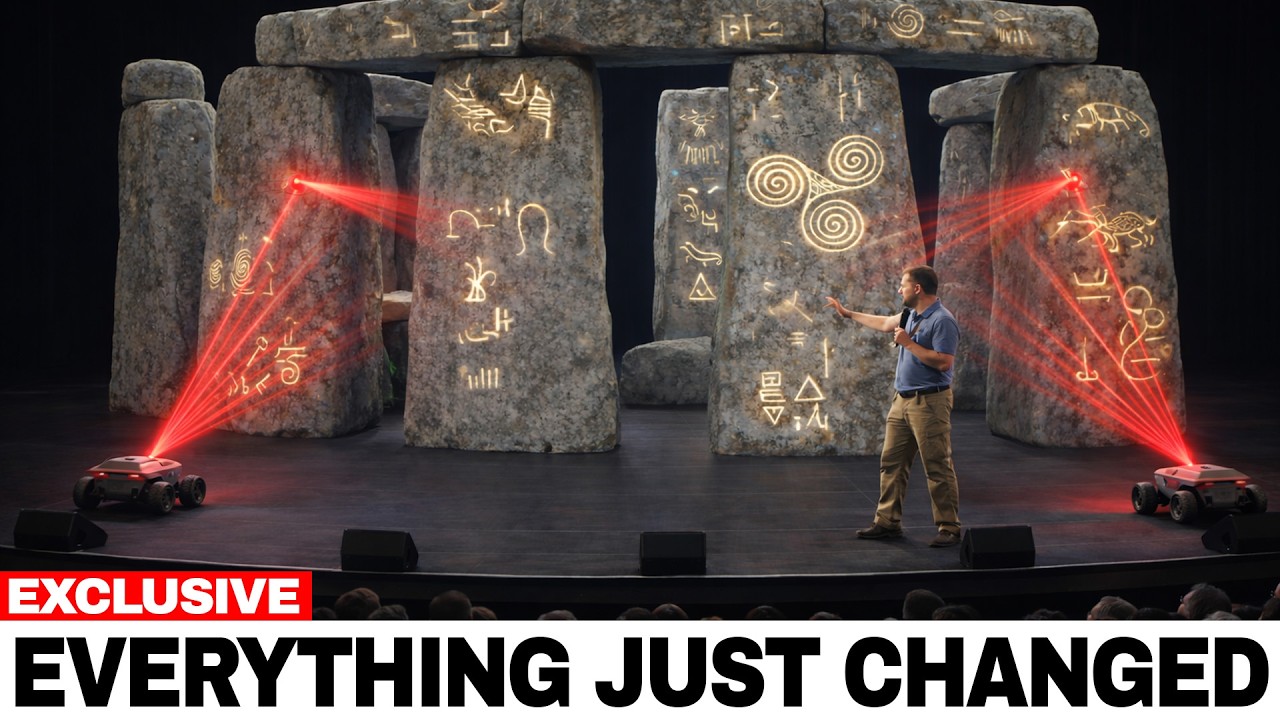
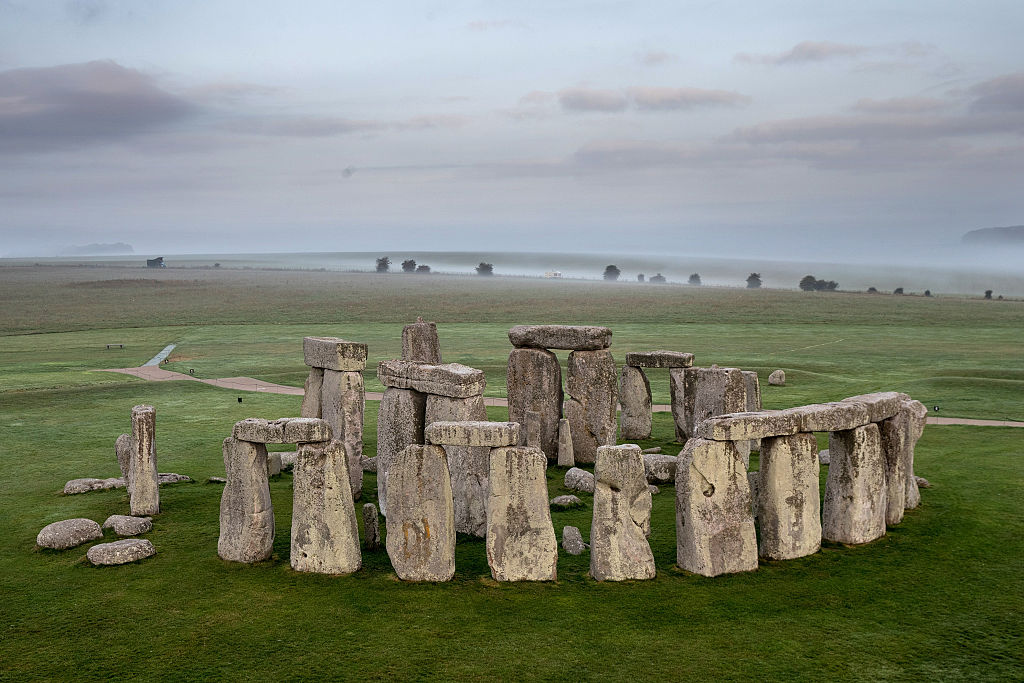
To understand Stonehenge, we must first forget its ruined form. Today, the monument appears fragmented—fallen lintels, missing uprights, gaps in the circle. But in its prime, it was a continuous ring of towering sarsen stones capped with lintels, forming an enclosed circular chamber. Within that ring stood a horseshoe of mᴀssive trilithons, creating what was effectively a stone “room.”
In 2020, acoustic engineer Trevor Cox and his team at the University of Salford reconstructed this original structure using laser scans, digital simulations, and a 1:12 physical scale model tested inside an anechoic chamber. Their findings were striking.
The completed Stonehenge would have produced reverberation similar to a small concert hall. Sound waves reflecting across the circular enclosure reinforced certain frequencies while canceling others. Speech from the center would have been amplified. External noise would have faded.
In other words, stepping inside would not have felt like standing in an open field. It would have felt like entering an acoustic chamber—an engineered sonic environment.
Some researchers speculate that the geometry may even have generated infrasound—frequencies below 20 hertz, too low to consciously hear but powerful enough to feel. Studies in psychoacoustics link infrasound exposure to sensations of awe, anxiety, chills, and even the feeling of a presence in the room.
If Stonehenge amplified such frequencies, the effect would not have been intellectual. It would have been visceral.
The precision of its design becomes even more astonishing when we examine the stones themselves.
The mᴀssive sarsen stones, weighing up to 25 tons each, were transported roughly 15 miles from West Woods. This alone required immense coordination—hundreds, perhaps thousands, of workers hauling megaliths without wheels, metal tools, or draft animals.
But the smaller “bluestones” are the true enigma. Each weighing between two and five tons, they originated in the Preseli Hills of West Wales—approximately 150 miles away. Geological fingerprinting has matched specific stones at Stonehenge to specific Welsh outcrops.
And in 2024, researchers proposed that the six-ton Altar Stone at the monument’s heart may have originated in northeast Scotland—over 700 miles away.
Transporting multi-ton stones across Britain in the Neolithic era would have required coordinated maritime travel, knowledge of tides and currents, and collaboration among distant communities. This was not a local project. It was a national mobilization.
The builders did not subsтιтute materials. They demanded specific stones from specific places. The material itself mattered.
Just two miles away lies Durrington Walls, the largest known Neolithic settlement in Britain. Excavations revealed remains of what may have been up to 1,000 houses, capable of housing perhaps 4,000 people.
Radiocarbon dating suggests this settlement was occupied for only a few decades—possibly as little as ten years around 2500 BCE. It appears to have been a construction camp.
Archaeologists uncovered more than 38,000 animal bone fragments, mostly pigs slaughtered in midwinter. Isotopic analysis shows livestock were driven from across Britain—from Wales, Devon, northern England, even Scotland.
Thousands traveled for weeks, bringing their best animals to feast and labor. There was no written language, no centralized government, no currency. And yet the coordination succeeded.
What kind of authority inspires that level of commitment?
Perhaps not authority in the modern sense—but engineered experience.
Stonehenge is famously aligned with the summer solstice sunrise. But new research highlights equally significant lunar alignments. Cremated remains cluster in the southeastern arc of the circle, facing the moon’s southernmost rising position during a major lunar standstill—an event occurring only every 18.6 years.
In 2024–2025, during the latest standstill cycle, researchers documented the moon rising almost perfectly within the predicted alignment framed by the station stones.
Even more provocative is the possibility that some sightlines once aligned with stars that have since shifted due to Earth’s 26,000-year axial precession. If true, Stonehenge encodes not just annual or generational cycles—but cosmic cycles spanning millennia.
This is not a simple calendar. A calendar tells you the date. Stonehenge may tell you where you are in the life of the cosmos.
When we layer the evidence—acoustics, geology, organization, astronomy—a pattern emerges.
Imagine traveling for weeks to reach Salisbury Plain. You join thousands in midwinter feasts. At dawn, you enter the completed stone circle. The outside world falls silent. Your voice echoes back altered. A vibration hums in your chest. Then a shaft of sunlight or moonlight pierces the interior at a precisely predicted moment.
Sound, light, geometry, and time converge.
You would not need to be told this place was sacred. Your nervous system would tell you.
In this interpretation, Stonehenge was not merely a symbol of belief—it was a device for generating it. The monument itself produced the authority it represented.
And perhaps that is the most unsettling conclusion of all.
Because 5,000 years later, the mechanism still functions. The solstices arrive. The moon reaches its standstill. The acoustics respond. The alignments hold.
Stonehenge may not be a relic of a primitive past. It may be a durable message—one written in stone, sound, and celestial motion.
The question is no longer whether we have solved Stonehenge.
It is whether we fully understand what we are standing inside.


