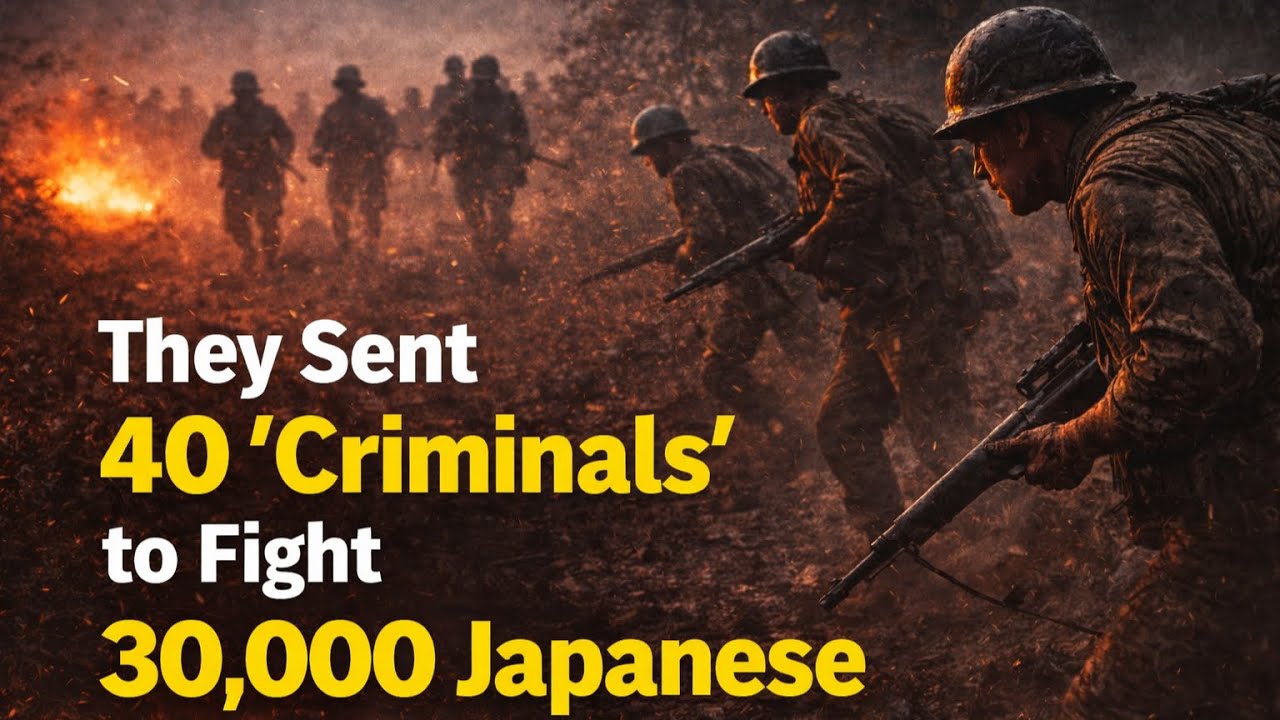
Saipan 1944. 40 men chosen from the brig and disciplinary squads formed the US military’s most secretive reconnaissance unit.
Before joining the military, they weren’t just regular soldiers.
Some were mob bodyguards, habitual thieves, or professional boxers.
The selection criteria for their commander were simple.
Win every fight and strike to kill.
Armed with nothing more than outdated rifles, relics from World War I, they were tasked with facing off against 30,000 Japanese soldiers who were determined to fight to the death.
The average casualty rate for this mission over 73%.
These troublemakers who ignored the rules now had to fight their way through the enemy’s rear and carve a bloody path to survival.
The story begins on June 15th, 1944 at 8:00 a.
m.
Lieutenant Frank Taheski was curled up inside a Higgins landing craft only 300 yards away from the southern beach of Saipan.
Japanese artillery shells slammed into the surrounding waters, exploding in towering waves of spray.
At 29, this Marine officer from New Brighton, Pennsylvania, had behind him a group of 40 extraordinary soldiers.
All of them had been carefully selected from disciplinary units.
Their mission clear, infiltrate behind enemy lines, act alone for several days, and combat the entire Japanese garrison on the island.
Intelligence had confirmed that approximately 30,000 Japanese troops were stationed on the island.
However, this reconnaissance sniper unit had only been trained for 6 months at the Teroa camp in Hawaii.
Saipen would be their first real test in battle.
The Marine Corps had already compiled statistics.
Reconnaissance snipers in the Pacific theater had an average casualty rate of 73%.
This meant that more than 70% of them would likely never return from the island.
This was not the first time the Marine Corps had tried to form such an elite reconnaissance unit.
7 months earlier, after the brutal battle of Terawa, Colonel James Lejun of the sixth marine regiment had urgently requested the formation of a specialized reconnaissance sniper unit.
During the Terawa campaign, 994 Marines had died in just 76 hours.
Ljun knew that if they could precisely gather intelligence on Japanese defensive positions, many lives could be spared.
What he needed were not ordinary soldiers, but individuals who could silently eliminate the enemy, chart enemy positions, and survive alone behind enemy lines.
Regular Marine Corps training could produce excellent riflemen and ᴀssault troops.
But he was looking for misfits, people capable of independent thinking, willing to break the rules, and skilled in covert tactics.
And these men, he found, were in the disciplinary units.
Tahesky’s recruitment standard was blunt.
Any marine who fought in a brawl and won was selected.
Those with disciplinary records proved they could survive in close combat.
The Marine Corps called them troublemakers, but Tahesky referred to them as survivors.
At the Teroa camp over two months, he handpicked 42 Marines from various disciplinary units of the Second Marine Division.
The youngest was 17, the oldest was 34.
Most had criminal records before enlisting, either arrested for theft or ᴀssault, or were professional boxers.
One was even a bodyguard for a Chicago mobster.
The Marines offered them a choice.
Go to military prison or go to war.
Without a doubt, all of them chose the latter.
The training at Teroa camp was unlike anything regular Marines learned.
Knife fighting, unarmed, silent kills, how to break a century’s neck without making a sound, and how to move through the jungle without disturbing even a blade of grᴀss.
In addition, they were trained to read Japanese maps and call in naval and artillery support.
The soldiers used M1903 Springfield rifles with eight time scopes, training to hit humansized targets at 600 yardds.
They also trained with the bazooka rocket launcher to destroy tanks and fortified positions, all while learning Japanese tactics and island defense deployments.
Even more notably, they also had to learn how to steal.
In 1944, the Marine Corps was notorious for its lack of equipment.
They were still using leftover weapons from World War I, and even their rations were insufficient.
To survive, they had no choice but to borrow supplies from better stocked army and navy units.
Tahesky’s men became expert thieves, raiding army supply depots for food, sneaking into Navy warehouses to steal equipment, and even daring to drive off with jeeps and trucks.
Other Marines in the Sixth Regiment gave them the nickname the 40 Thieves, a тιтle that would stick.
By June 1944, the 40 Thieves had completed their training.
They were skilled in hand-to-hand combat, experts in stealth, able to kill silently, and had memorized Japanese defense strategies.
They had gone over aerial pH๏τographs of Saipan countless times.
Their mission was clear.
Follow the first wave of ᴀssault troops ashore, advance inland before the main force, locate Japanese positions, and send back coordinates.
Then they would infiltrate the jungle to continue mapping the enemy’s movements.
They would operate behind enemy lines for several days without any support and if captured there would be no rescue.
The intelligence briefing was blunt.
Saipan was the first time the US military would invade Japanese territory, not a fortified island.
The Japanese would fight with suicidal determination.
The island was home to 30,000 Imperial Army and Navy troops along with thousands of armed civilians.
Saipan was 14 mi long and 5 mi wide with Mount Tapacow in the center rising 1,500 ft.
The Japanese had established observation posts at the mountaintop overseeing all beaches.
The island was filled with concrete bunkers, interconnected trenches, and underground shelters.
Every beach and valley was targeted by artillery.
Casualty estimates for the US military were over 50%.
At 8:47 a.
m.
, the ramp of the Higgins landing craft dropped with a clang, plunging into the deep water.
Tahesky and his team waited through the waves toward the beach with machine gun bullets splashing in the water around them.
Japanese mortars began pounding the ᴀssault units and Marines fell in the waves, on the beach, and near the breakwater.
But the 40 thieves did not stop.
They pushed inland, and by 9:30 a.
m.
they were already 300 yd from the beach, further than any other Marine unit.
At that moment, they were alone in enemy territory, surrounded by 30,000 Japanese soldiers in the jungle.
Nine hours later, night would fall and that’s when their real mission would begin.
The 40 thieves advanced through the dense jungle, keeping 50 yard distances, maintaining visual contact with hand signals designed by Taheski.
Regular marine units were required to maintain formation and stay in constant radio contact.
But Tahesky’s orders were the opposite.
His unit acted independently, made tactical decisions on their own, and only reported enemy positions.
This autonomy was theirs alone.
At 10:15 a.
m.
, Sergeant Bill Campbell discovered the first Japanese position, a concrete bunker embedded in the side of a ridge.
The bunker’s crossfire covered a valley that the Second Marine Division was scheduled to advance through later in the day.
Inside the bunker were a type 92 heavy machine gun and seven Japanese soldiers camouflaged so well that they were invisible from the beach.
Any advancing Marines would walk directly into the kill zone.
Tahesky’s map showed that all three marine routes would pᴀss within the machine guns range.
Destroying the bunker could save dozens, even hundreds of lives, but attacking it would expose their position and jeopardize the reconnaissance mission.
He thought for only 30 seconds before making his decision, they would use the bazooka.
Private Marvin Stromble moved into position 80 yards from the bunker while the rest of the team provided cover.
At 10:32 a.
m.
, Stromble pulled the trigger and the rocket accurately hit the firing slit, causing an internal explosion that killed all seven Japanese soldiers instantly.
Before the smoke even cleared, the 40 thieves had moved another 300 yards deeper into the jungle.
Apart from the destroyed bunker, there was no trace left behind.
4 hours later, when the second Marine Division’s troops pᴀssed through the valley, they encountered no machine gun fire from the ridge.
They had no idea that a group of misfits had quietly taken the enemy’s ᴅᴇᴀᴅly punch for them.
By noon, the 40 thieves had identified and mapped 17 Japanese positions, including eight machine gun nests, four mortar pits, three artillery observation posts, and two ammo depots.
Tahesky used secure communication to send the coordinates to battalion headquarters.
Within 20 minutes, naval destroyers began shelling these targets.
The team watched from concealed positions as 5-in shells obliterated the positions they had marked just 30 minutes earlier.
This was their mission.
Find the enemy, mark the targets, and move before the Japanese could react.
Earlier that afternoon, the team had advanced 2 mi inland, far beyond the reach of other Marine units, arriving in an area that the Third Marine Division wouldn’t reach for another 3 days.
For every 100 yards they advanced, they uncovered a new Japanese position.
The island’s defenses were far stronger than intelligence had estimated.
In one valley, Tahesky counted over 200 Japanese soldiers.
A direct ᴀssault would take days, but with accurate coordinates, naval gunfire could level the positions in just minutes.
The 40 thieves were quietly changing the way the Marine Corps fought.
At 3:40 p.
m.
, they spotted an unexpected target.
In the woods north of Charlo and Koya, a Japanese tank battalion had ᴀssembled with 37 Type 97 medium tanks covered completely by camouflage nets.
Marine intelligence had only estimated a dozen or so tanks in the area, and these tanks were the greatest threat to the beach head.
The Japanese plan to launch a large-scale tank attack at night during which naval artillery support would be significantly less effective.
If these 37 tanks launched a night ᴀssault on the beach, they could potentially break through the defenses and storm the vulnerable supply area.
Tahesky immediately sent the coordinates, but 8 minutes later, the battalion responded.
Naval gunfire was supporting the forces trapped on the beach.
Air strikes had already been ᴀssigned to other targets, and artillery was still being unloaded with no reinforcements available for at least 4 hours.
By then, it would be dark, and the tanks would likely have already moved.
Tahesky studied the tanks and calculated.
The unit had six bazookas, each with six rockets, 36 in total, just one less than the number of tanks.
This decision went against all tactical principles.
There was no way a 40-man unit should be attacking a tank battalion.
But Tahesky had recruited these men because they were not by the book soldiers.
They were survivors skilled in dirty tactics.
At 4:15 p.
m.
, he gave the order, “Prepare to attack.
” The 40 thieves would personally ᴀssault the tank battalion.
If they succeeded, they could avoid a disastrous defeat at the beach.
If they failed, all 40 would die there, and no one would ever know what had happened to them.
At 4:25 p.
m.
, six bazooka teams moved into a semi-ircular attack position, spaced 40 yards apart to maximize coverage.
But just as they were about to engage, the situation suddenly changed.
The 37 tank engines roared to life, shaking the jungle with their noise.
Japanese soldiers crawled out of their shelters and climbed into their vehicles.
Officers shouted commands and infantry began to ᴀssemble around the tanks.
This was not a retreat.
This was a preparation for attack.
Tahesky checked his watch.
It was 4:28 p.
m.
and [clears throat] the sunset was at 7:12 p.
m.
The Japanese were planning an evening ᴀssault much earlier than expected.
The enemy was fully alert and the window for their surprise attack had completely closed.
He quickly adjusted his orders, abandoned the attack, and shift to tracking the tank battalion, providing real-time updates on their movements.
Although they couldn’t directly engage, accurate coordinates would allow the Marines on the beach to set up defenses in advance.
He sent updated intelligence to battalion headquarters.
The Japanese tank battalion was mobilizing for an attack expected to reach the US defensive line between 7 and 8:00 p.
m.
[clears throat] Headquarters immediately replied, “Keep observing, avoid engagement, and continue reporting.
” At 5:07 p.
m.
, the Japanese tank battalion began advancing toward the coast in two columns with about 1,000 infantrymen following.
This was a full-scale attack, not a probing action.
If they broke through the defenses, they could destroy supply depots, artillery positions, and command centers before dark, potentially causing the entire US invasion operation to collapse overnight.
The 40 thieves kept 200 yards to the side of the enemy’s formation, using the jungle for cover as they tracked their movements, sending coordinates every 10 minutes.
The Marines on the beach quickly adjusted their deployment.
They distributed bazookas to the front lines, moved the second tank battalion’s Sherman tanks forward, and calibrated the artillery targets.
The entire second marine division braced for impact.
At 6:15 p.
m.
, about a mile from the beach, the Japanese forces stopped.
Officers convened a meeting.
Through binoculars, Tahesky saw from 300 yards away that the Japanese were debating.
One pointed toward the beach, another to the north, while a third spread out a map.
11 minutes later, the forces changed direction, moving north first, then west toward the coast.
At 7:05 p.
m.
, as the sun touched the horizon, Tahesky finally understood the Japanese plan.
They weren’t attacking the main beach head.
Instead, they were targeting the gap between the second and fourth Marine divisions.
If they broke through, they would split the US forces in two.
He immediately sent a warning, but the timing of the Japanese attack was ruthless.
As dusk fell, the Marines switched to their night operation frequencies, causing radio communications to become blocked.
The artillery was still reloading ammunition, and the Sherman tanks were refueling.
The gap between the two divisions was only defended by two marine companies, around 340 men who now had to face 37 tanks and 1,000 Japanese infantry.
At 7:23 p.
m.
, the Japanese launched their attack.
The 40 thieves watched from the high ground as the tanks advanced in the twilight.
Marine defensive positions immediately erupted with the roar of bazookas.
The first three tanks exploded in flames, but 34 tanks continued to press forward.
Japanese infantry screamed as they charged behind the tanks, and the Marines were forced to retreat.
Within 15 minutes, the enemy tanks would reach the beach.
At that moment, Tahesky noticed one Japanese tank break away from the main force and head straight down a ravine toward the six marine regiment’s command post where Colonel James Lley was coordinating the division’s defense.
This type 97 tank was moving at 15 mph in the dark, heading for a 200yd stretch of weak jungle defense, an area where anti-tank weapons were hard to deploy.
If the tank reached the command post and destroyed the radio and killed the senior officers, the entire regiment’s defense would collapse.
Colonel Lidley was only 400 yardds away, completely unaware of the danger.
Tahesky had only 3 minutes.
He grabbed the best bazooka gunner in his unit, Private Herbert Hedges.
Hedges had scored six hits in six sH๏τs during training, but training targets didn’t move, didn’t fight back, and certainly didn’t have armor that could deflect rockets.
The Type 97 tank’s frontal armor was 50 mm thick, and if the rocket was fired at the wrong angle, it would ricochet.
Hedges had to hit the thinner side armor with precision.
At 7:31 p.
m.
, the two of them sprinted down the slope and took up a position 30 yards along the tank’s path.
Hedges dropped to his belly and aimed.
20 seconds later, the tank emerged from the ravine, its turret rotating as it searched for targets.
The commander stood in the open hatch using binoculars to observe.
As the tank slowed to a stop and the commander consulted the map, Hedges squeezed the trigger.
At exactly 7:32 p.
m.
, the rocket hit the left side armor just below the turret ring, penetrating the crew compartment and causing an explosion that killed four Japanese soldiers instantly.
6 seconds later, the tank’s ammunition exploded and a fireball lit up the jungle for 300 yd.
Nearby Japanese infantry, thinking they had encountered a major American force, turned their attention toward the site and launched an ᴀssault.
This rocket not only destroyed the tank, but also inadvertently drew the entire Japanese infantry unit away from the weakly defended command post, leaving it unharmed.
However, the flash from the bazooka revealed their position.
The Japanese within 500 yardds immediately opened fire with machine guns and mortars.
The unit had to retreat immediately or they would be wiped out.
Through the gunfire and mortar explosions, they made their way through the jungle, putting their training to the ultimate test.
Conventional tactics called for group movement, but the jungle terrain and enemy fire made that impossible.
The units split into smaller squads of four or five men and moved independently to pre-desated rally points.
Japanese patrols searched the area and on several occasions they came dangerously close to the 40 thieves.
The men relied on silent movement and concealment, avoiding firefights at all costs.
One gunfight could attract a devastating response.
At 8:05 p.
m.
, Sergeant [clears throat] Strombble’s squad encountered seven Japanese patrol soldiers.
The squad crouched motionless in the underbrush, and one Japanese soldier stopped just 10 ft away, staring into the darkness for 43 seconds.
He never saw them, and the squad was able to slip away.
At 900 p.
m.
about half of the squad, 23 men, reached the main rally point, an open area 600 yards behind the Marine defensive line.
17 men were still missing.
According to conventional tactics, they should wait for 2 hours, but the area was too close to enemy positions, and Japanese patrols were still searching.
Tahesky decided to take the ᴀssembled men back to the defensive line first and send out a rescue team for the missing at dawn.
At 9:41 p.
m.
, they safely entered the friendly controlled area using their pre-arranged identification signals and pᴀssword.
The Japanese tank attack continued throughout the night, and by 3:14 a.
m.
, enemy armored units were still probing the beach defenses.
In the end, US Marines destroyed 11 tanks with bazookas, nine with Sherman tanks, and seven with artillery.
By the dawn of June 16th, the Japanese had lost 27 out of their 37 tanks, and their attack had failed.
However, the Marines paid a heavy price.
78 men from the Second Battalion, Sixth Marine Regiment, were killed or wounded, and 19 from Company F, Second Marine Battalion.
The gap between the two divisions was barely held.
At dawn, Tesky formed a search and rescue team with each team consisting of four men tasked with finding the 17 missing personnel before noon.
At 7:05 a.
m.
, the rescue team found the first body, Private Donald Evans, who had been sH๏τ twice in the chest, likely killed during the retreat.
His dog tags had been taken by the Japanese, who often collected US dog tags as war trophies.
The team marked his position with rifles and helmets, then buried him shallowly.
At 8:20 a.
m.
, another team found three bodies.
These Marines had been captured and executed, their hands bound behind their backs, and they had been stabbed with bayonets.
Japanese forces on Saipan rarely took prisoners.
The Imperial Army considered surrender a disgrace and had little respect for enemy soldiers who surrendered.
These three men had been wounded, captured, and then brutally killed.
By 10:00 a.
m.
, the rescue team had found six of the missing survivors who had returned to the lines on their own after being separated during the night.
By then, 29 men had returned to the unit, but 13 were still missing.
At 11:15 a.
m.
, a rescue team sent a radio message.
They had found five Marines alive, but trapped by a Japanese patrol in a cave system about a mile behind enemy lines.
They were unable to move.
Tahesky faced a decision.
He could request artillery support to create a diversion, allowing the trapped Marines to escape, but this would expose the US military’s interest in the area.
Alternatively, he could send a rescue team immediately and rely on stealth and speed to extract them.
He chose the ladder, informed a six-man rescue team, which set out at 11:47 a.
m.
At 12:33 p.
m.
, the rescue team arrived at the cave.
The trapped Marines were exhausted and dehydrated.
One had a high fever of 39.
4° 4° C from malaria and another was suffering from dysentery and could barely walk.
After distributing water and medical supplies, the rescue team decided to evacuate immediately.
These men wouldn’t survive 12 more hours and would have to cross a mile of Japanese controlled territory before dark.
At 1:00 p.
m.
, the 11man combined team began to move toward the friendly lines.
After advancing 400 yardds, they encountered a 20man Japanese patrol.
Tahesky decided to ambush them.
Eight men positioned along the patrol’s route while three men blocked the rear.
In 30 seconds, they wiped out the entire patrol, preventing them from sending a distress signal.
At 1:23 p.
m.
, the Japanese patrol entered the kill zone.
The 11 Marines fired simultaneously, killing all 20 Japanese soldiers in 7 seconds.
But the gunfire echoed across half a mile, and the Japanese quickly began to surround them.
The [clears throat] team moved at full speed, abandoning stealth with the sounds of enemy orders and whistles closing in behind them.
At 1:29 p.
m.
, they reached a steep ravine 40 ft deep.
Going around would take an additional 15 minutes and climbing would greatly slow them down, but staying on the ridge would result in being overtaken by the pursuing enemy.
Tahesky decided to cross the ravine.
The men slid and crawled down to the bottom, helping the two sick Marines along the way.
One minute later, the Japanese appeared on the ridge above and began firing down at them.
Bullets ricocheted off the rocks.
One Marine was sH๏τ in the leg while another was hit by shrapnel from a grenade that exploded in the ravine.
The team returned fire as they continued to advance.
At 1:38 p.
m.
, the team discovered that the end of the ravine was a ᴅᴇᴀᴅend box canyon, trapping them completely.
The Japanese were advancing from multiple directions.
Tahesky countered at least 40 enemy soldiers with more reinforcements arriving.
His 11-man team had only about 200 rounds of ammunition left, and two of the Marines were too sick to fight.
The remaining nine combat ready Marines would have to face an increasing number of enemies.
Artillery and air support were not possible due to the proximity of enemy and friendly forces.
So, the 40 thieves had no choice but to fight alone.
In the face of this desperate situation, Tahesky noticed a detail the Japanese had overlooked.
The back wall of the ravine was not solid rock, and the vegetation at the bottom indicated there was seepage, suggesting that the rock was cracked.
He sent two men to investigate while the others set up a defensive position.
At 1:44 p.
m.
, the scouts returned with a report.
Behind the vegetation, there was a narrow opening that allowed only one person to pᴀss sideways.
The crack behind it expanded into an upward slanting rock pᴀssage.
The team pᴀssed through one by one, first pushing the two sick men through.
The pᴀssage was dark and narrow, forcing the Marines to remove their backpacks and drag them along, moving by feel and following the lead of the team ahead.
The Japanese had already entered the ravine and were searching and calling out for the Americans who had seemingly vanished.
At 2:07 p.
m.
, the pᴀssage opened on the other side of the ridge, 400 yardds from the entrance.
The team was now behind enemy lines, but the Japanese attention was still focused on the ravine below.
They advanced at full speed toward the marine position, covering the final 600 yardd in 8 minutes.
Using pre-arranged identification signals, they safely entered the friendly control zone with all 11 men escaping unscathed.
The two sick men were immediately sent to the medical station.
By then, 34 team members had returned, but eight remained missing.
Later that day, three missing Marines managed to evade the Japanese and return to the lines.
The advancing Marines found two bodies.
By dusk on June 16th, three Marines were still unaccounted for and were officially listed as missing.
In their first battle on Saipan, within 48 hours, the 40 thieves suffered at least six killed, three missing presumed ᴅᴇᴀᴅ, and a casualty rate of 22%.
Despite these heavy losses, they had successfully completed their mission, identifying over 200 Japanese positions, guiding artillery to destroy dozens of fortifications, preventing a tank ᴀssault, and providing crucial intelligence that repeatedly turned the tide of the battle.
Colonel James Lun sent a message to Taheski.
Rest for the night, starting at 6:00 p.
m.
, resupply and receive reinforcements.
On June 17th, the mission would take them deeper into enemy territory.
By then, approximately 29,000 Japanese troops remained on Saipan, while only 37 40 thieves remained.
On June 17th at 5:30 a.
m.
, the 40 thieves left the Marine lines in total darkness with the goal of reaching a ridge system 3 mi inland.
Intelligence had indicated that Japanese artillery positions were located there, having shelled US positions for two days, causing dozens of casualties and disrupting supply lines.
Because the Japanese had concealed the artillery in caves, aerial reconnaissance was unable to locate them, leaving only ground reconnaissance, requiring the 40 thieves to venture further into enemy territory than any other American unit on Saipan had done.
The team maintained absolute silence throughout, using hand signals to communicate.
The first mile took 47 minutes with no encounters with Japanese patrols.
The second mile, due to the steep terrain and dense vegetation, slowed their pace.
At 8:15 a.
m.
, they reached the target ridge and began systematic reconnaissance.
The ridge was about 2 mi long, rising 600 ft above the surrounding jungle with Japanese positions scattered throughout.
Tahesky counted eight cave entrances large enough to house artillery connected by tunnels.
The Japanese could move artillery between these positions and after firing several rounds quickly retreat to avoid American counterattacks.
This explained why Marine artillery had never been able to destroy these positions.
Finding the artillery was only part of the mission.
The 40 thieves also needed to map out the tunnel system to provide the ᴀssault units with critical information for future attacks.
This required them to enter the caves themselves.
At 9:40 a.
m.
, Corporal Rosco Marins and Private Marvin Stromber volunteered while the rest of the team stood guard outside the cave.
The two men [clears throat] carried small flashlights to shield their light and entered the largest cave.
After advancing 200 ft, the tunnel split and they could hear Japanese voices deeper inside.
The cave was filled with a smell of gunpowder and human waste.
At 10:12 a.
m.
they discovered the first artillery piece, a type 91 105 mm howitzer with ammunition stored in a crevice in the rock and no crew present.
After marking the position, they continued deeper.
Within 40 minutes, they discovered two more artillery pieces, a command post, a warehouse containing around 2,000 rounds of ammunition, and a barracks capable of housing at least 60 soldiers.
The scale of the tunnel system was far beyond what intelligence had estimated.
At 11:03 a.
m.
, they heard the footsteps of Japanese soldiers approaching.
The two men had just 15 seconds to hide.
They pressed themselves against a small niche and remained completely still.
12 Japanese soldiers pᴀssed within 3 ft of them, conversing in Japanese and did not detect their presence.
Once the patrol left, they decided to retreat.
The intelligence gathered was sufficient, and staying any longer could lead to capture.
At 11:27 a.
m.
, they returned to the team.
After studying the map, Tahesky realized that a conventional ᴀssault on the position would be ineffective.
All the cave entrances were covered by machine guns, and infantry couldn’t storm them.
The artillery would struggle to destroy deeply buried targets.
The only solution was to use explosives to seal the entrances, trapping the Japanese inside and then destroy them one by one.
However, engineers would need several more days to arrive.
At 12:15 p.
m.
, the team turned their attention to a secondary target, Gapan Town, the administrative capital of Saipan before the war.
Marine intelligence needed confirmation of whether the Japanese had fortified the town or withdrawn to more defensible positions inland.
Reaching Gerapan would require crossing four miles of Japanese controlled territory during the day, but the 40 thieves had already been operating behind enemy lines for over 30 hours, and Tahesky believed they could complete the reconnaissance and safely withdraw.
At 3:40 p.
m.
, the team approached Garrapan from the east.
The town, heavily damaged by US air strikes and naval bombardments, still had signs of Japanese activity among the ruins, indicating that the enemy was still garrisoned there.
To determine enemy strength in deployment, at 4:05 p.
m.
, Taheski made a decision that would go down in Marine Corps history.
Five team members would infiltrate Garrapan in broad daylight for reconnaissance and return with intelligence.
This was almost a suicide mission, but it was precisely the kind of task the 40 thieves thrived on.
Tahesky selected Stromber, Marins, Sergeant Iraqi, Dawn Evans, and himself, forming a team of five.
They removed any equipment that could make noise, cantens, excess ammunition, and grenades, and only carried their rifles, knives, and pistols.
At 4:23 p.
m.
, the team began moving towards the eastern edge of Garrapan.
The ruins provided cover, but also concealed Japanese positions.
Every destroyed building, every pile of rubble could be hiding enemies.
At 4:41 p.
m.
, the team infiltrated the town’s back streets, moving in the shadows.
Japanese soldiers were visible everywhere and there were at least 200 soldiers in the town center with potentially hundreds more in surrounding buildings.
They realized that the Japanese had not turned Garrapan into a strong defensive position but rather used it as a rallying point for a counteroffensive against the Americans.
This distinction was crucial for the Marine commanders planning the attack.
Those intending to ᴀssault Garrapan needed to know that they were facing a mobile force, not a fixed defense.
At 5:08 p.
m.
, Tahesky made an unexpected discovery.
Five Japanese military bicycles leaning against a partially destroyed building, the kind used by officers for commuting.
A bold idea instantly took shape.
Five bicycles, five team members disguised as Japanese soldiers riding bikes for reconnaissance.
In the chaos of Gerapon, soldiers riding bikes were much less likely to attract attention than hidden infantry.
This plan was extremely risky and completely against conventional reconnaissance procedures, but Tahesky approved it without hesitation.
At 5:15 p.
m.
, the team mounted the bicycles and casually rode through the ruins, not trying to hide, but acting like ordinary Japanese soldiers commuting.
The Japanese soldiers saw them but paid no attention.
Some even waved while others greeted them in Japanese.
And the Marine team responded with hand signals despite not understanding the language.
In 43 minutes, the 40 thieves cycled through the occupied capital, mapping positions, counting enemy troops, and marking supply stations.
They pᴀssed by Japanese officers several times without being discovered.
At 5:58 p.
m.
they completed the reconnaissance, rode out of Gapon, and began retreating north.
After riding a mile, they returned to the jungle.
This reconnaissance provided the Marines with detailed intelligence on the Japanese deployment in Gapon, laying the foundation for the upcoming ᴀssault.
At 7:32 p.
m.
, the 40 thieves returned to the Marine lines.
They had been operating behind enemy lines for 14 hours.
covering a distance deeper into Japanese controlled territory than any other US unit had achieved.
In the following three weeks, they continued similar missions, mapping Japanese positions in the interior of Saipan, directing artillery strikes, ambushing Japanese patrols.
The intelligence they provided saved countless Marine lives.
They also witnessed Japanese atrocities.
Civilians were forced to jump off cliffs rather than surrender.
Wounded Marines were used as bait for ambushes and prisoners of war were executed.
The team operated in small units, sometimes going for days without contact with the main force.
They suffered from malaria, dysentery, and heat stroke.
And when their rations ran out, they stole supplies from the Japanese.
When they were out of water, they drank from contaminated streams.
On July 9th, 1944, Saipan was declared fully occupied.
The 40 thieves suffered 12 ᴅᴇᴀᴅ, nine wounded with a casualty rate of 56%, far lower than the average 73% casualty rate, but still devastating.
The survivors were physically and mentally exhausted with most losing 30 to 40 lbs and many suffering from recurring malaria.
All of them had witnessed horrors they would never forget, but their achievements were monumental.
Marine commanders estimated that the 40 thieves reconnaissance efforts reduced overall marine casualties by at least 15%, saving the lives of approximately 2,000 soldiers.
The unit later participated in the Battle of Tinian in July 1944 and then returned to Saipan for mop-up operations.
After the war, most of the team members struggled with post-traumatic stress disorder.
Some suffered from nightmares, others became alcoholics and some could not maintain normal lives.
Their psychological wounds were never officially recognized or treated.
Frank Tahesky returned to civilian life and was later elected as the mayor of Sturgeon Bay, Wisconsin.
He never spoke about his war experiences.
It wasn’t until his death in 2011 that [clears throat] his son Joseph discovered his military box and the story of the 40 thieves came to light.
For 66 years, the actions of this unit, which changed the tactics of the Marine Corps, were almost unknown.
The Sixth Marine Regiment’s reconnaissance sniper platoon was one of the earliest elite special operations units in US military history.
Their deep behind enemy lines reconnaissance, silent kills, and independent operating tactics profoundly influenced the development of modern special forces, including the SEALs and Marine Recon.
They proved that small elite units could accomplish missions that entire regiments could not.
These 40 problem soldiers who came from disciplinary barracks and correctional units ultimately became one of the most battleh hardened units on the Pacific battlefield.
The Marine colleagues who had called them criminals were wrong.
They were true warriors.
If Tahesky and the 40 thieves story moved you, please like and support it so that more people can learn about this forgotten piece of history.
Subscribe and turn on notifications.
We push out untold stories every day.
You’re also welcome to leave a comment and share where you’re from.
Tell me if your family had relatives who participated in World War II, especially in the Pacific theater.
Thank you for watching.
Frank Tahesky and his 40 thieves deserve to be remembered forever.
These men gave everything for the freedom of future generations.
Through your views, likes, and shares, you’re helping to ensure their memory lives on, never to be forgotten.


