The killing of Mexico’s most powerful cartel leader has sent shockwaves far beyond the mountains where the operation unfolded. What authorities are calling the most significant blow yet against the Jalisco New Generation Cartel, or CJNG, has left entire regions on edge, sparked retaliatory violence, and forced tourists and residents alike into sudden uncertainty.
On Sunday, the Mexican army confirmed it had killed Nemesio Rubén Oseguera Cervantes, widely known as “El Mencho,” during a military operation in Tapalpa, a mountainous area roughly two hours southwest of Guadalajara in Jalisco state. According to officials, troops attempting to capture him came under intense gunfire. The confrontation quickly escalated into a full-scale firefight.

Authorities reported that at least four people were killed at the scene, while three others—including Oseguera—were wounded and later died while being transported to Mexico City. Three Mexican soldiers were also injured. By the time the dust settled, security forces had seized armored vehicles, rocket launchers, and high-powered firearms—an arsenal that underscored the military-grade strength of the cartel.
But the operation did not end with the gunfire in Tapalpa. Within hours, retaliation rippled outward.
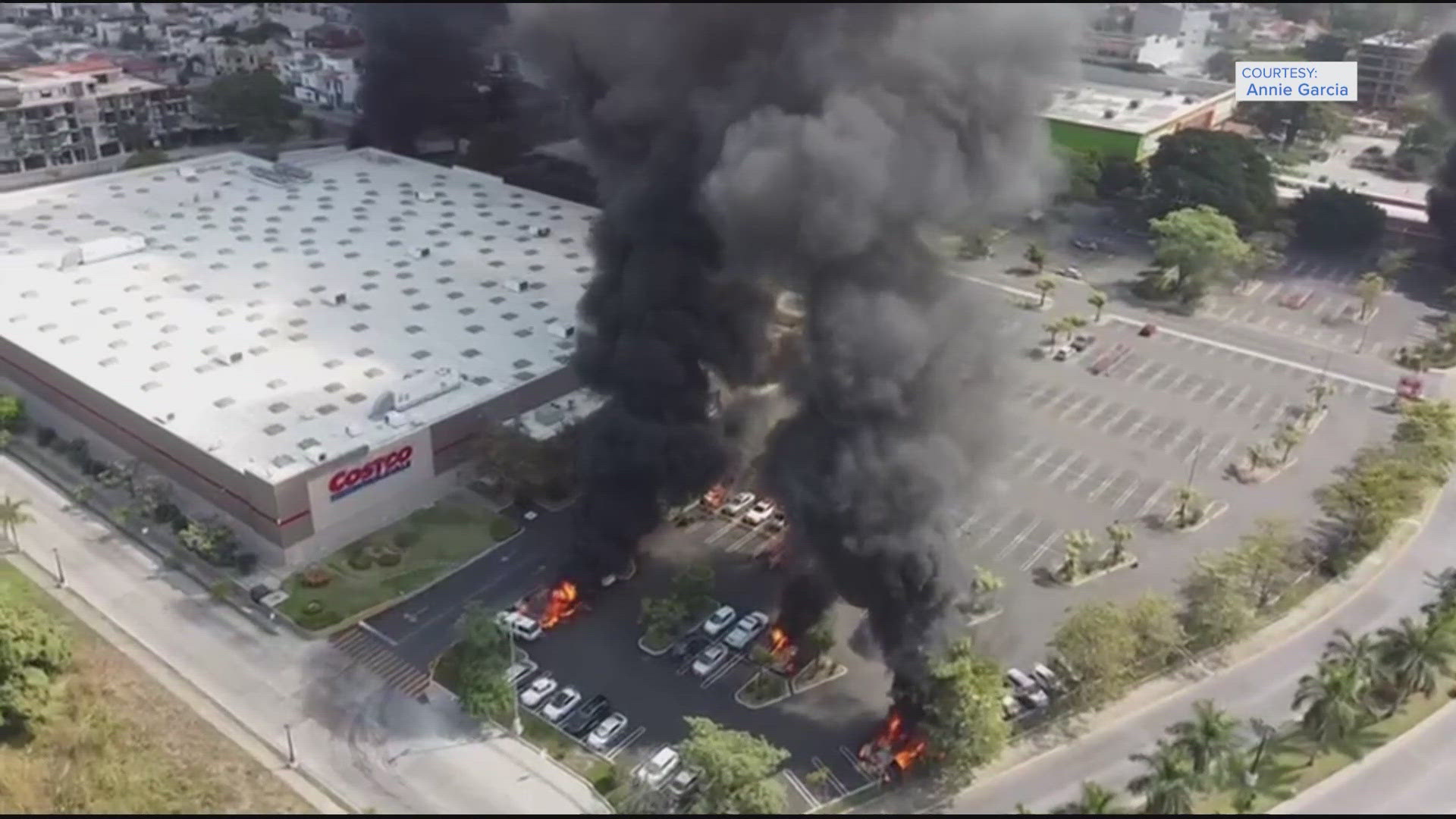
Across Jalisco and neighboring areas, cartel members reportedly set vehicles ablaze and blocked key highways. In Puerto Vallarta, a major tourist destination, more than ten vehicles were torched. Roads in Guadalajara were obstructed. Several Oxxo convenience stores were burned or vandalized. Thick black smoke drifted above coastal skylines typically ᴀssociated with vacation pH๏τos, not crisis footage.

The state government activated a statewide security alert, closing schools, suspending public transportation, and canceling large events. Flights into Puerto Vallarta were disrupted, with some aircraft reportedly turned around midair. Air Canada suspended flights to the region, citing security concerns.
For the thousands of tourists vacationing along Jalisco’s coastline, the shift from relaxation to alarm was abrupt.
In smaller beach towns north of Puerto Vallarta, visitors described shuttered businesses and near-empty streets within hours of the news breaking. Shops pulled down metal grates. Restaurants closed their doors. Grocery stores were briefly overwhelmed as tourists rushed to stock up on bottled water and basic supplies. The atmosphere was tense but restrained—a kind of cautious shutdown driven more by fear of the unknown than by direct violence in those communities.

Local residents, accustomed to periodic cartel-related disruptions, responded with swift precaution. In many towns, there is typically only one main road in and out. When reports of highway blockades surfaced, movement became risky. Travelers heading to airports were told to stay put as burning vehicles blocked critical routes.
While some areas experienced direct acts of arson and road blockades, other towns remained physically untouched yet psychologically impacted. Rumors spread rapidly across social media—claims that airports were completely shut down, that certain cities were under siege, or that cartel convoys were heading toward tourist districts. Many of these reports proved exaggerated or false, but in the absence of immediate official communication, uncertainty filled the void.

The U.S. State Department expanded its shelter-in-place advisory for Americans in affected regions, urging caution and limited travel. The Embᴀssy of India issued similar guidance for its citizens in Jalisco and nearby states, advising them to avoid areas near security operations and remain in close contact with family members.
From Washington, the White House confirmed it had shared intelligence with Mexican authorities ahead of the operation. U.S. officials described the killing as a major victory in the fight against transnational organized crime, particularly given CJNG’s central role in trafficking fentanyl into the United States. A $15 million bounty had long been offered for information leading to El Mencho’s capture.

Yet on the ground, the immediate concern was less about geopolitics and more about safety and logistics. Tourists whose flights were canceled scrambled to rebook. Families waited for updates from airlines and consulates. Some attempted to contact U.S. diplomatic offices but reported difficulty reaching personnel, particularly given that the operation occurred on a Sunday.
By Monday, conditions in several coastal towns had begun to stabilize. Businesses cautiously reopened. Restaurants resumed limited service. Beachgoers slowly returned, though not in typical numbers. The difference between Sunday’s near-deserted streets and Monday’s partial recovery was striking.
Still, the broader picture remained complicated.

According to additional reporting from the ᴀssociated Press, at least 73 people died in the attempted capture and the violent aftermath, including Mexican security personnel, suspected cartel members, and others. The Defense Department confirmed further arrests and the seizure of weapons and armored vehicles, signaling that the operation extended beyond a single target.
The scale of casualties illustrates the magnitude of the confrontation and the ferocity of CJNG’s response. Under El Mencho’s leadership, the cartel had grown into one of the most heavily armed criminal organizations in the hemisphere. Known for its willingness to directly challenge the state, CJNG had previously demonstrated its firepower by attacking military convoys and even downing a helicopter in 2015.

The death of such a figure inevitably raises questions about what comes next.
Historically, the removal of a cartel leader can lead to temporary surges in violence as factions compete for control or seek to demonstrate continued strength. Analysts caution that CJNG’s infrastructure—its financial networks, trafficking routes, and regional commanders—remains intact unless systematically dismantled. A single operation, no matter how significant, does not erase the organization overnight.
For local economies dependent on tourism, prolonged instability could carry serious consequences. Jalisco’s coastal towns rely heavily on international visitors, especially during peak travel season. Images of burning cars and blocked highways can reverberate globally, affecting bookings and investor confidence long after calm returns.

At the same time, many residents express cautious optimism that the worst of the immediate retaliation may pᴀss within days, as has occurred in previous cartel crackdowns. But uncertainty lingers, particularly given the unprecedented scale of this operation and the prominence of its target.
Information management has also become a critical issue. In the first 24 hours, official updates were limited, allowing rumors to flourish online. Conflicting reports about airport closures and urban sieges circulated widely. Journalists on the ground emphasized the importance of verifying sources and relying on established news outlets rather than unconfirmed social media posts.
As armed patrols continue across parts of Jalisco and federal authorities ᴀssess the full impact of the raid, Mexico finds itself at a pivotal moment. Officials are calling the killing of El Mencho a historic victory against organized crime. Yet history suggests that such milestones often come with turbulent aftermaths.
For now, highways are reopening in stages. Flights are gradually resuming. Beach towns are inching back toward normalcy. But beneath the surface calm, the country braces for what the coming days may reveal—whether this marks a turning point in Mexico’s long struggle against cartel power or simply another volatile chapter in an ongoing war.


