“It Happened in Just Minutes” — Victoria’s Coastal Towns Submerged as Floodwaters Swallowed the Streets
Along the winding stretch of the Great Ocean Road, where cliffs usually frame postcard sunsets and tourists pause for pH๏τographs, something shifted without ceremony.

The sky over Victoria darkened in a way locals would later struggle to describe—not dramatic at first, not cinematic, just heavy.
The kind of heaviness that presses against your ribs before you understand why.
By nightfall, Wye River and Lorne were no longer quiet coastal towns.
They were front lines.
Rain began as a steady percussion on rooftops, familiar and almost comforting.
Then it changed tempo.
Within hours, water cascaded down hillsides, funneled through narrow streets, and pooled where it had no business being.
Residents would later insist the forecasts had mentioned rain, yes—but nothing that hinted at what followed.
Some say the warnings were underestimated.
Others argue they were ignored.
The distinction may matter less than the outcome.
Security cameras captured the first unsettling images.
Headlights flickered through sheets of rain.
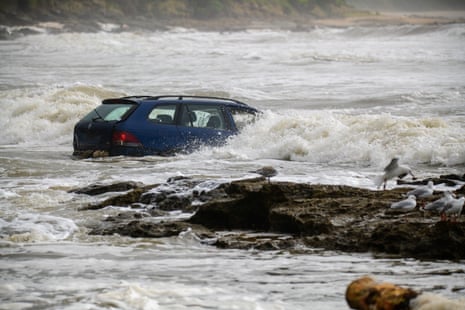
A parked SUV shuddered, lifted slightly, then began to drift.
Another vehicle followed, rotating slowly as if reconsidering its own weight.
In less than a minute, both were carried downstream, colliding with a fence that snapped like a brittle twig.
The footage circulated quickly, stripped of context but heavy with implication.
To some viewers, it looked like a freak weather event.
To others, it felt like a preview.
Emergency services were dispatched as calls flooded in—reports of submerged roads, blocked culverts, water breaching shopfronts.
Yet responders faced an adversary that moved faster than coordination.
The topography of these towns—steep hills descending abruptly toward the sea—creates a natural channel.
When rain intensifies beyond a threshold, gravity becomes an accomplice.
Water does not hesitate.
It chooses the quickest path down.
In Wye River, a narrow bridge that usually carries little more than local traffic became a choke point.
Debris—branches, loose signage, fragments of fencing—jammed against its supports.
With nowhere to go, water rose rapidly, spilling over embankments and into adjacent properties.
One resident described watching her garden disappear “like someone erased it with a wet brush.” She had lived there for twenty years and had seen storms before.“But not like that,” she insisted, though she struggled to define what “that” meant.
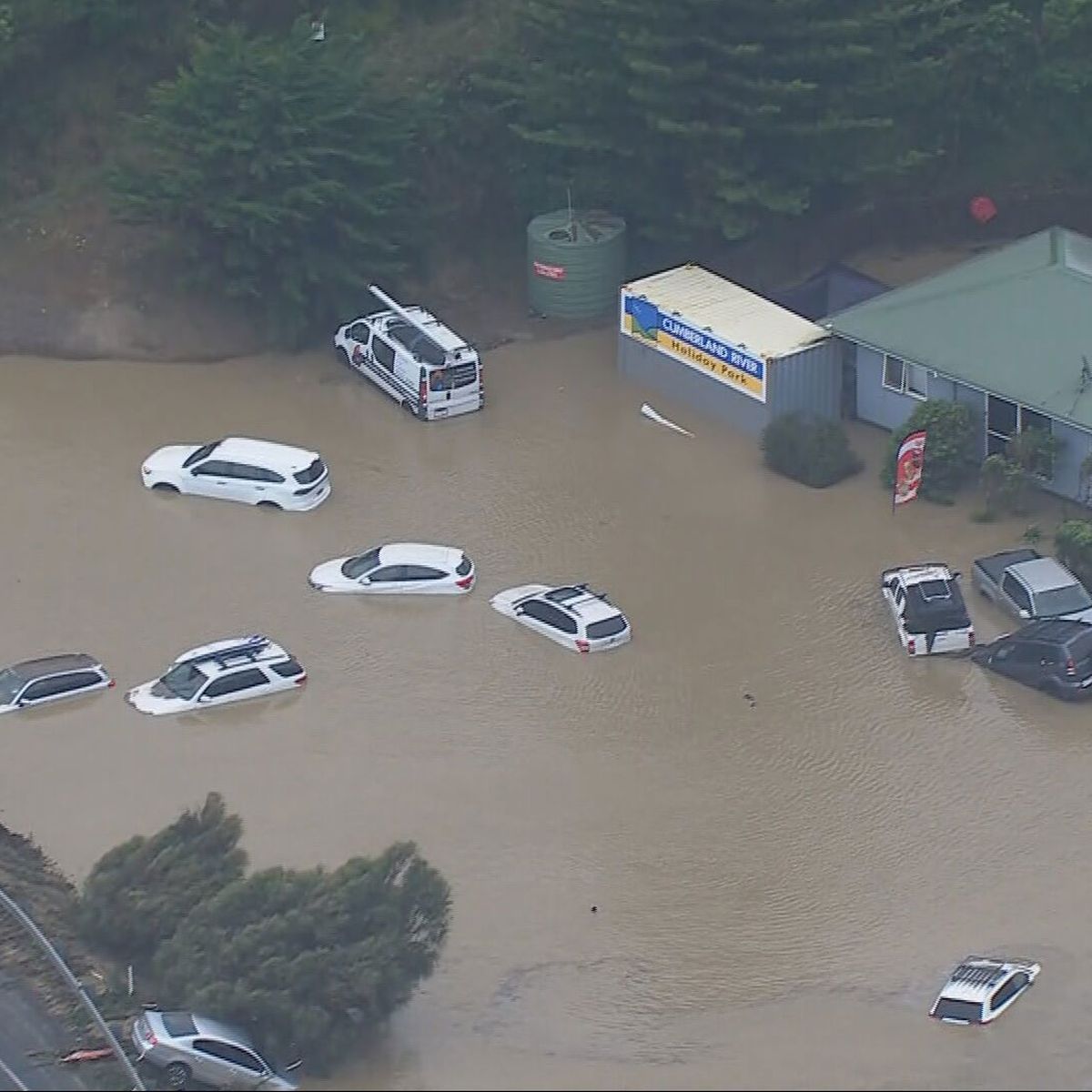
Lorne, a town accustomed to seasonal influxes of visitors, found its main streets transformed into shallow, churning canals.
Shop owners who had secured doors against wind now faced water pushing from below, seeping through thresholds and vents.
Some tried to salvage inventory.
Others simply watched as the floor disappeared under opaque brown currents.
A café owner later admitted he hesitated too long before cutting power, unwilling to believe the water would reach the sockets.
It did.
Meteorologists would later explain the event as a convergence of intense rainfall bands and saturated ground conditions.
The soil, already burdened from previous showers, could absorb little more.
Once the absorption limit was reached, runoff accelerated.
On paper, it reads like a sequence of predictable variables.
On the ground, it felt less predictable.
Residents noted the speed.
“Minutes,” one said.
“It changed in minutes.” Whether that is technically precise is almost irrelevant.
Perception often lingers longer than data.
There is also the uncomfortable question of infrastructure.
Drainage systems are designed for anticipated extremes—but what happens when the extreme recalibrates itself? Climate scientists have long warned that weather patterns are shifting, that once-rare events may grow more frequent.
Still, when such warnings materialize in a specific place at a specific hour, theory becomes tangible.
The debate that followed was swift and polarized.
Was this an unavoidable act of nature? Or a failure of planning layered over years?
Cars lodged against trees the following morning looked less like property damage and more like punctuation marks.
Each one told a partial story.
A silver sedan found half-submerged near the riverbank suggested an attempted escape interrupted mid-route.
A delivery van resting awkwardly against a lamppost hinted at someone who believed they had more time.
No fatalities were immediately reported, a fact authorities emphasized.
But absence of tragedy does not equate to absence of trauma.
Power outages compounded the disorientation.
In certain pockets, darkness fell earlier than expected as transformers tripped.
Without streetlights, residents navigated by phone screens and memory.
The soundscape shifted too.
Instead of the usual hush of a coastal evening, there was the persistent rush of water and the occasional metallic crash as debris found resistance.
Some claimed they heard what sounded like distant cracking—perhaps tree limbs giving way, perhaps something else.
In high-stress moments, interpretation stretches.
By dawn, helicopters surveyed the damage from above.
Aerial images revealed the geometry of the flood: thin veins of brown slicing through neighborhoods, pooling at intersections, retreating only reluctantly.
From that vantage point, the pattern looked almost deliberate.
Online commentators were quick to draw broader conclusions.
Climate change.
Government neglect.
Media exaggeration.
The truth, as usual, likely resides in the overlap—but overlap does not trend.
Authorities urged caution, advising residents to avoid driving through standing water.
The phrase is familiar, repeated after nearly every flood event worldwide.
Yet the footage from Wye River and Lorne illustrates why the warning persists.
It takes less depth than most drivers ᴀssume to unmoor a vehicle.
Once buoyancy overcomes traction, control is an illusion.
Several rescues were conducted as individuals found themselves stranded atop car roofs or trapped in properties where water had risen unexpectedly fast.
Insurance ᴀssessors began their quiet work soon after.
Clipboards replaced sandbags.
Damage is tallied, categorized, monetized.
But numbers rarely capture the more elusive consequences.
The sense that a boundary has been crossed.
That what felt stable yesterday may not be stable tomorrow.
In interviews, some residents spoke of rebuilding.
Others hinted at reconsidering.
“We love it here,” one couple said, glancing toward the hills that had funneled the water down.
“But love doesn’t stop rain.”
What complicates the narrative further is memory.
Older locals recall previous floods—episodes that were severe but not catastrophic.
They remember community clean-ups, shared meals, resilience stories.
This event, however, seemed to accelerate beyond those reference points.
Whether that acceleration is measurable or psychological may be debated.
The impression it left is harder to dismiss.
There were also moments of quiet solidarity.
Neighbors formed impromptu chains to move belongings to higher ground.
A volunteer group arrived with portable pumps before formal ᴀssistance reached certain streets.
Social media, often criticized for amplifying panic, also became a coordination tool—alerts about blocked roads, updates on water levels, offers of spare rooms.
Crisis reveals fractures, but it can also reveal connective tissue.
Still, the images persist.
Cars spinning.
Water claiming asphalt.
A bridge straining under debris.
They invite interpretation.
Some observers frame the flood as a stark emblem of a warming planet, an early chapter in a longer story.
Others resist that framing, cautioning against drawing sweeping conclusions from a single event.
Yet even skepticism does not erase the footage.
In the days that followed, the water receded, leaving behind sediment and questions.
Mud coated shop floors.
Lawns were littered with objects that had traveled farther than intended—children’s toys, fragments of signage, a lone shoe whose owner remains unknown.
Cleanup began methodically, almost clinically.
Pressure washers hummed.
Piles of ruined drywall grew at curbsides.
The visible damage was addressed.
The less visible adjustments—changes in perception, in planning, in confidence—will take longer.
Meteorological agencies will analyze rainfall totals and compare them against historical baselines.
Engineers will review drainage capacity and structural resilience.
Policymakers may promise reviews or upgrades.
Whether those processes translate into tangible change is another matter.
For now, the people of Wye River and Lorne live with a new reference point.
It is tempting to reduce the event to a headline: flash flooding in coastal Victoria.
Accurate, concise, and incomplete.
Because beneath the measurable facts lies something more unsettling—the realization that environments we consider familiar can pivot rapidly.
That a calm afternoon can dissolve into urgency without theatrical buildup.
And that when water decides to redraw boundaries, it does so without consultation.
As the Great Ocean Road resumes its rhythm and visitors return, traces of the flood may fade from casual view.
But for those who watched their cars drift or their floors disappear under opaque currents, the memory will remain textured and immediate.
They will monitor forecasts differently.
They will listen for shifts in rainfall intensity with sharper ears.
Was this a singular anomaly, a statistical spike destined to be contextualized and archived? Or a signal embedded within a broader transformation? Experts will continue to debate probabilities and projections.
Meanwhile, the towns themselves carry evidence etched in silt lines along walls and in the cautious glances residents cast toward the hills when clouds gather again.
In the end, perhaps the most disquieting aspect is not the force of the water but the speed of its arrival.
The sense that between normalcy and disruption lies only a narrow interval.
In Wye River and Lorne, that interval closed quickly.
Whether it reopens wide enough to reᴀssure—or narrows further in seasons ahead—remains an open question.


