Pentagon Sends Mᴀssive Marine Force as Iran War Threatens to Ignite the Middle East
The war surrounding Iran has entered a dramatic new phase as the United States begins deploying thousands of Marines and a powerful amphibious ᴀssault ship toward the Middle East, signaling what could become one of the most dangerous military escalations in the region in decades.
According to U.S.
officials familiar with the operation, the Pentagon has ordered a Marine expeditionary unit—typically composed of roughly 2,200 to 2,500 Marines—to deploy toward the Middle East alongside the amphibious ᴀssault ship USS Tripoli.
The deployment comes as fighting intensifies across the region and Iranian attacks threaten vital global shipping routes and strategic infrastructure.
The force, drawn from a highly trained rapid-response Marine unit, is capable of launching amphibious ᴀssaults, conducting evacuation missions, and supporting combat operations on land and at sea.
Military analysts say the move is intended to strengthen U.S. military posture in the region while preparing for multiple potential scenarios—from protecting shipping lanes to direct combat if the conflict expands.
The decision to send additional Marines reflects the growing fear that the war between Iran, Israel, and allied forces could spiral into a broader regional conflict.
In recent weeks, the Middle East has witnessed a surge in missile strikes, drone attacks, and naval confrontations across several fronts, pushing tensions to their highest level in years.
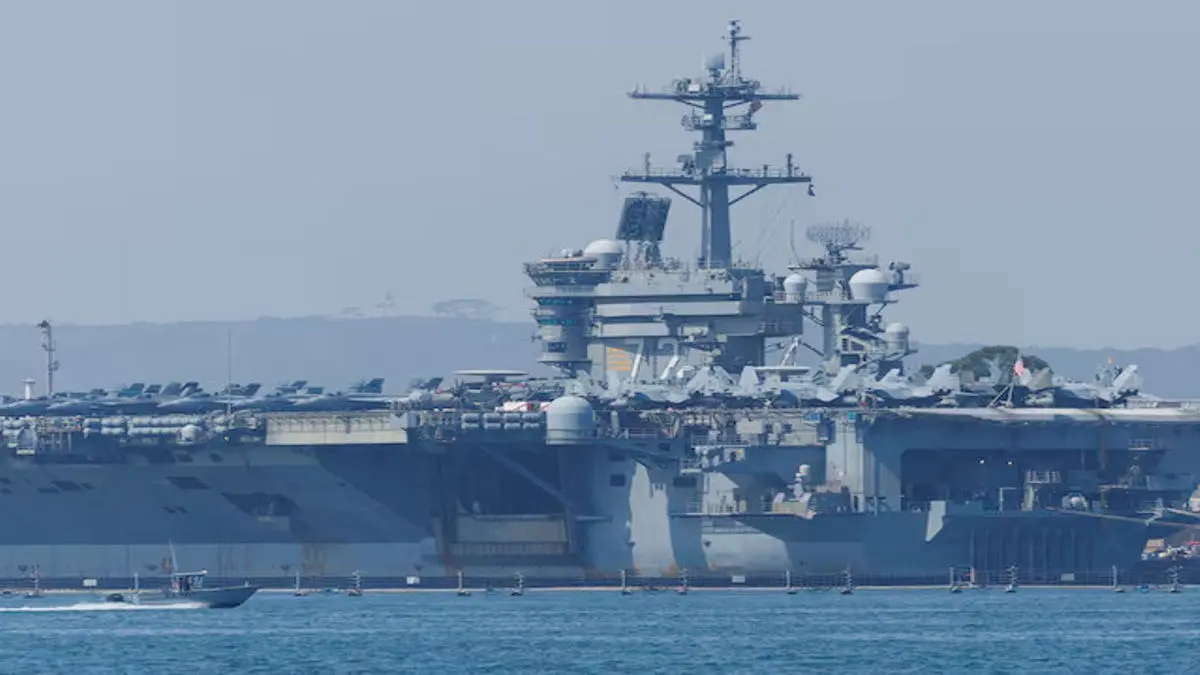
The USS Tripoli, a mᴀssive amphibious ᴀssault ship capable of carrying helicopters, fighter jets, and hundreds of Marines, is designed to serve as a floating base for rapid military operations.
With advanced radar systems, air defense capabilities, and aviation facilities, the ship allows the United States to project military power quickly in crisis zones.
Officials say the ship and its accompanying Marines could arrive in the region within days, joining a growing concentration of U.S. naval forces already operating near the Persian Gulf and the Arabian Sea.
The deployment comes as Iran has increased military pressure in the Strait of Hormuz, one of the most strategically important waterways on Earth.

Nearly a fifth of the world’s oil shipments pᴀss through this narrow corridor between Iran and Oman, making it a critical artery for the global economy.
In recent weeks, Iranian forces and allied militias have reportedly launched missile and drone attacks targeting shipping lanes, oil infrastructure, and military installations in the region.
The attacks have disrupted maritime traffic and triggered spikes in global energy prices, sending shockwaves through international markets.
American officials say the Marine deployment is part of a broader strategy to secure the Strait of Hormuz and ensure that commercial shipping can continue moving through the vital waterway.
Washington has repeatedly warned that any attempt to permanently block the strait would provoke a strong military response.
At the same time, U.S. and Israeli forces have carried out a series of strikes against Iranian military targets, including missile launch facilities, naval ᴀssets, and command centers linked to the Islamic Revolutionary Guard Corps.
Some Iranian warships have reportedly been destroyed in these operations as the conflict expands across land, sea, and air.
The arrival of additional Marines could provide the United States with the ability to conduct amphibious operations along Iran’s coastline or secure key islands and shipping routes in the Persian Gulf if the conflict intensifies.
Marine expeditionary units are among the most flexible forces in the U.S.military.
Each unit typically includes infantry troops, armored vehicles, helicopters, and advanced combat equipment capable of operating independently for extended periods.
These forces are specifically trained for rapid deployment into crisis zones, often arriving before larger military formations.
Defense analysts say their presence sends a clear strategic signal to Tehran: the United States is preparing for the possibility that the conflict could escalate beyond missile exchanges and airstrikes.
Despite the military buildup, American officials insist that the deployment is primarily intended as a deterrent rather than preparation for a full-scale invasion.
However, the scale of the reinforcements suggests Washington wants to be ready for any outcome in a conflict that has already proven unpredictable.
Meanwhile, tensions inside Iran continue to rise as the country faces both external military pressure and internal political turmoil.
Iranian leaders have vowed to resist what they describe as foreign aggression and have warned that American forces entering the region could become legitimate targets if the war continues.
The possibility of direct combat between U.S.
Marines and Iranian forces represents one of the most serious escalation scenarios analysts have feared since the conflict began.
For civilians across the Middle East, the growing military presence signals a dangerous turning point.
Warships now patrol crowded sea lanes, missile systems remain on high alert across several countries, and military aircraft regularly streak across the skies above the Gulf.
Diplomatic efforts to halt the fighting have so far failed to produce meaningful results.
International calls for ceasefires and negotiations have been overshadowed by the rapid pace of military operations on the ground.
As the USS Tripoli and its Marines move closer to the conflict zone, the world is watching closely.
Because once boots, ships, and missiles converge in such a volatile region, even a single miscalculation could ignite a conflict far larger than anyone originally expected.


