WARNING: Sakurajima’s Toxic Emissions Surge – What Are Nearby Residents Facing? 🌫️🌋
For years, the people living in the shadow of Sakurajima have learned to measure time differently.
Not by clocks, but by ashfall.
Not by calendars, but by tremors.
A thin film of gray dust on a car windshield can mean nothing—or everything.
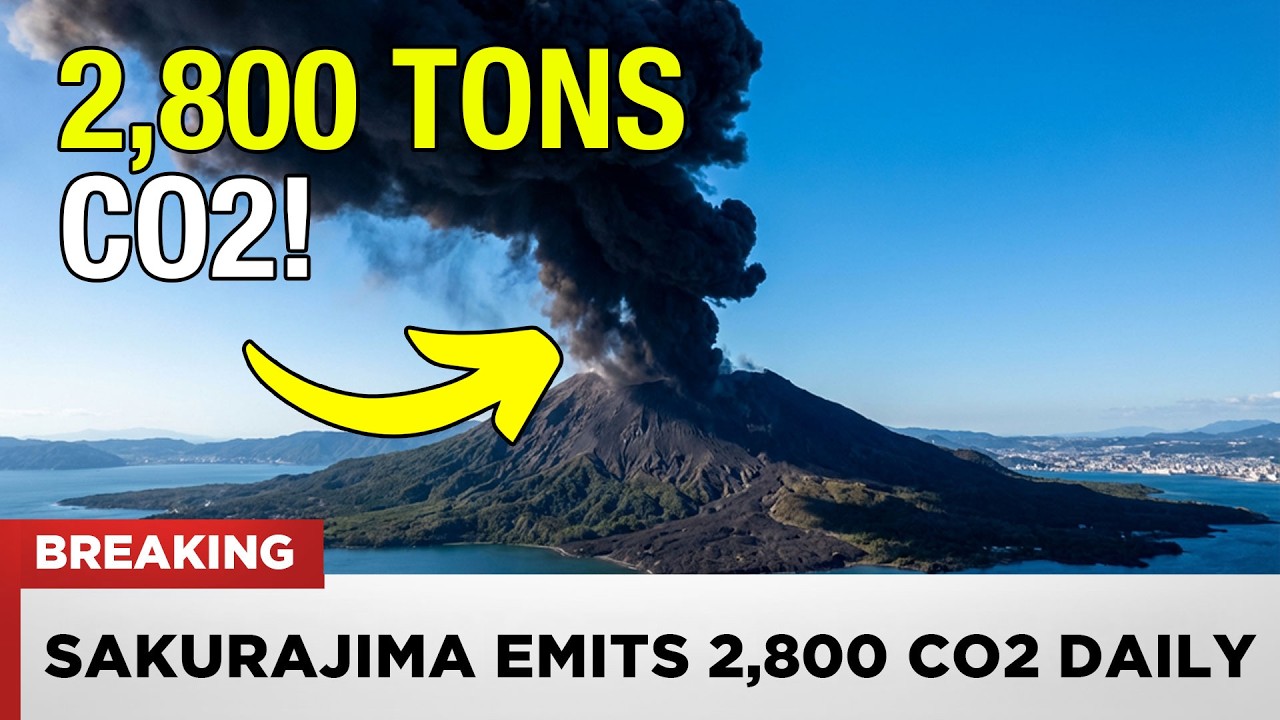
And now, with daily sulfur dioxide emissions estimated at roughly 2,800 tons, the familiar rhythm of this volcano feels subtly, unsettlingly altered.
Official statements describe the activity as “elevated but not extraordinary.
” Data charts show fluctuations, peaks and dips that can be explained within known volcanic behavior.
Yet numbers, stripped of context, can be deceptive.
Two thousand eight hundred tons of SO₂ per day is not a poetic metaphor.
It is an atmospheric burden.
It seeps into lungs, reacts with moisture, drifts invisibly beyond the crater’s rim.
It lingers.
Residents in Kagoshima Prefecture are no strangers to volcanic warnings.
Emergency kits sit near doorways.
Masks are not a novelty.
Schools conduct drills with mechanical precision.
Life continues—ferries cross the bay, shops open on schedule, commuters move through routine.
But beneath the choreography of normalcy is a question no one voices too loudly: is this simply another phase in a long geological conversation, or the prelude to something that will not be so easily managed?
What makes the current situation particularly arresting is not only what rises into the air, but what lies below.
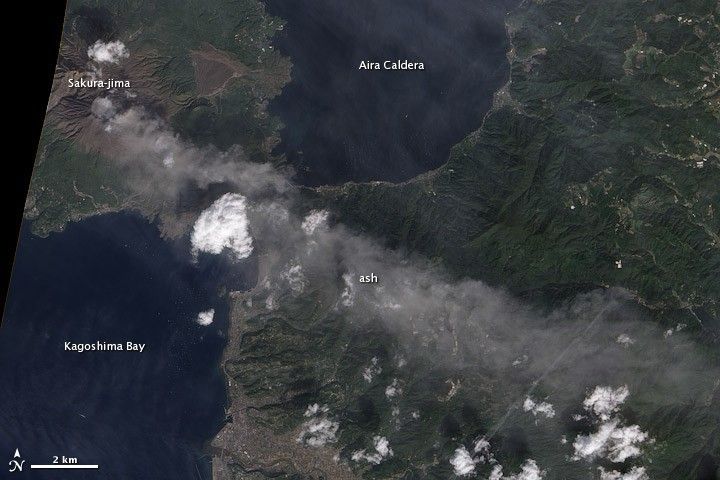
Beneath the restless cone stretches the vast structure of Aira Caldera, a remnant of ancient cataclysms that reshaped southern Japan thousands of years ago.
The caldera is not a dramatic peak visible on postcards.
It is a depression, a scar, a memory of eruption on a scale that defies modern comprehension.
It is also, according to geophysical surveys, very much alive.
Scientists are careful with their language.
“Magma movement.” “Degᴀssing events.” “Pressure redistribution.” These phrases carry authority, but they also conceal the raw uncertainty inherent in volcanic systems.
The Earth does not operate on human timelines.
A caldera can remain deceptively calm for centuries before releasing its stored energy in hours.
It can also grumble and vent without escalating into disaster.
The ambiguity is the most unnerving element of all.
Recent monitoring reports indicate sustained high gas output, accompanied by intermittent explosive activity at the summit crater.
None of this, in isolation, guarantees escalation.
Yet the coupling of persistent degᴀssing with the structural presence of a mᴀssive magma reservoir beneath invites speculation.
Gas, after all, is often a symptom.
It is the exhale of something deeper.
Local authorities emphasize preparedness, not panic.
Alert levels are adjusted methodically.
Evacuation perimeters are defined with mathematical care.
Aviation advisories are issued when ash plumes reach critical alтιтudes.
The machinery of risk management hums steadily in the background.
And still, the sight of a dense plume rising against the sky has a primal effect.
It triggers instincts older than language.
For older residents, memory adds another layer.
They recall previous eruptions when ash fell thick as snow, when windows rattled through the night, when headlines briefly turned global attention toward this corner of Japan.
Each episode pᴀssed.
Reconstruction followed.
The world moved on.

But history, especially geological history, rarely repeats in identical form.
It evolves.
Volcanologists privately acknowledge that predicting the exact trajectory of an active system is closer to probability ᴀssessment than prophecy.
Instruments measure seismic tremors, ground deformation, gas composition.
Satellites detect subtle swelling of the earth’s surface.
Algorithms parse patterns.
Yet the Earth retains veto power over every forecast.
The more disquieting discussions circulate not in official bulletins, but in academic corridors and late-night forums where experts debate worst-case scenarios with clinical detachment.
What if sustained degᴀssing indicates a larger body of magma rising? What if pressure redistribution within the caldera alters established pathways? What if the current phase is not an isolated pulse, but part of a longer buildup?
No one declares such outcomes imminent.
That would be irresponsible.
And yet, the very existence of these questions hints at the limits of certainty.
Air quality readings in nearby districts occasionally spike during heavy emission days.
Sensitive individuals report irritation.
Crops accumulate fine ash when winds shift unfavorably.
These are manageable impacts—so far.
Infrastructure remains intact.
Transportation routes remain open.
But volcanic crises often pivot on thresholds.
A change in wind direction.
A sudden increase in seismicity.
A vent that opens where none existed before.
The geography compounds the stakes.
Kagoshima City, with hundreds of thousands of residents, sits across the bay.
The visual proximity of the volcano is almost intimate.
On clear days, it dominates the horizon, majestic and immovable.
On active days, it appears less like a landmark and more like a reminder.
International observers have begun paying closer attention as emission figures circulate through global monitoring networks.
High SO₂ output is not unprecedented for active stratovolcanoes, but sustained levels attract scrutiny.
Comparisons are drawn to other volcanic systems worldwide.
Patterns are analyzed.
Analogies proposed.
None are perfectly reᴀssuring.
There is also the psychological dimension.
In an era defined by rapid information flow, images of ash clouds and gas measurements travel faster than the plumes themselves.
Social media amplifies uncertainty.
Speculation multiplies.
Some voices minimize the situation as routine.
Others escalate it into apocalyptic narrative.
The truth, as usual, resists such binaries.
It is tempting to frame the situation as a countdown.
Humans crave timelines, milestones, definitive outcomes.
But volcanoes do not offer countdown clocks.
They offer signals—sometimes clear, sometimes contradictory.
They escalate and de-escalate.
They lull and then surprise.
Geologically, the presence of a large caldera system beneath an active cone is not unusual.
Many volcanic regions function through layered complexity.
What distinguishes this case is the historical magnitude of past eruptions in the region and the dense modern population now living within potential impact zones.
The interplay between ancient forces and contemporary society adds a layer of tension that no monitoring instrument can fully quantify.
Emergency planners quietly review contingency frameworks.
Hospitals ᴀssess capacity.
Schools refine communication protocols.
These measures are procedural, not alarmist.
Yet preparedness itself can feel like an omen.
At dusk, when the plume is backlit by fading sunlight, the scene acquires an almost theatrical quality.
The column appears solid, sculpted, rising with deliberate intent.
It is easy, in such moments, to project narrative onto nature—to imagine intention where there is only physics.
But perception shapes reaction, and reaction shapes policy.
Some experts argue that heightened gas output can relieve pressure, acting as a safety valve.
Others caution that gas release may signal magma ascent.
Both interpretations can coexist.
Both can be correct in different contexts.
The challenge lies in discerning which context applies here, now.
Meanwhile, daily life persists.
Fishermen cast nets.
Tourists pH๏τograph the skyline.
Children walk to school under a sky that sometimes carries a faint sulfuric tang.
Resilience becomes routine.
And yet, beneath resilience, there is watchfulness.
The Earth beneath southern Japan has a long memory.
It has fractured, erupted, collapsed, and rebuilt itself over millennia.
The current phase may subside quietly, recorded only in datasets and annual reports.
Or it may mark the opening chapter of a more consequential episode.
At present, evidence supports vigilance, not alarm.
But vigilance, sustained over time, carries its own weight.
In the end, the most unsettling aspect of the situation is not what is known.
It is what cannot be known with precision.
Two thousand eight hundred tons of sulfur dioxide per day is a measurable fact.
The trajectory of the magma system beneath is not.
For now, instruments continue to record.
Scientists continue to analyze.
Authorities continue to prepare.
And above the bay, the plume continues to rise—sometimes thin, sometimes dense, always suggestive.
Whether this is merely another breath in a long geological cycle, or the intake before something far more forceful, remains uncertain.
The volcano does not explain itself.
It does not negotiate.
It simply signals.
And those watching—residents, scientists, officials—are left to interpret those signals, aware that interpretation, in the realm of fire and stone, is never an exact science.


