For centuries, one of the most sacred locations in Christianity remained sealed beneath layers of stone, marble, and tradition.
Believers traveled from across the world to stand before the Church of the Holy Sepulcher in Jerusalem, convinced that beneath its walls lay the burial place of Jesus Christ.
Yet despite its importance, the interior of the tomb itself had not been opened or examined in hundreds of years.
The physical reality beneath the shrine remained hidden, protected not only by stone but by fear of disturbing a site considered holy beyond measure.
That silence was broken in October of 2016, when an unprecedented restoration project brought archaeologists, conservation experts, and religious authorities together for a historic undertaking.

For the first time in centuries, the marble covering the tomb was carefully removed, allowing experts to examine what lay beneath.
What they discovered did not offer simple answers, but it reshaped how history, faith, and archaeology intersect at one of the most significant religious sites in the world.
The Church of the Holy Sepulcher has long been believed to mark the location of both the crucifixion and burial of Jesus.
Over nearly two thousand years, the structure has been damaged by earthquakes, fires, invasions, and repeated reconstructions.
Each generation added protective layers, reinforcing the site while also concealing its original form.
The tomb itself, housed within a small shrine known as the Edicule, was sealed with marble slabs as early as the sixteenth century, possibly even earlier, to prevent deterioration and interference by pilgrims.
By the early twenty first century, structural ᴀssessments revealed that the Edicule was in danger of collapse.
Cracks had appeared, moisture had weakened the stone, and the weight of centuries threatened the integrity of the structure.
Preservation was no longer optional.
It became a necessity.
However, restoring the tomb was not simply a technical challenge.
It was a religious and diplomatic one.
The Church of the Holy Sepulcher is jointly overseen by three major Christian communities, the Greek Orthodox, the Armenian Apostolic, and the Roman Catholic churches.
Their shared governance is regulated by a strict arrangement known as the status quo, established in the nineteenth century to prevent conflict.
Under this system, no change may be made without unanimous consent.
Even the smallest adjustments require agreement from all parties.
As a result, negotiations to restore the tomb stretched across decades, beginning as early as 1959.
One of the most visible symbols of this delicate balance is a simple wooden ladder resting above the church entrance.
It has remained in the same position for more than two centuries because no group can move it without collective approval.
This frozen detail reflects the broader reality of shared authority that governs every aspect of the site.
Another unusual tradition further illustrates this balance.
The keys to the church are not held by any Christian authority.
Instead, a Muslim family has been responsible for opening and closing the doors each day for generations.
This arrangement, dating back to the Ottoman era, was designed to maintain neutrality and prevent disputes among Christian groups.
It continues to this day and is widely respected.
In 2015, faced with the imminent risk of structural failure, the three Christian communities reached a rare agreement.
They authorized a full conservation project, including temporary access to the sealed tomb.
This decision marked a historic moment of cooperation and trust.
When restoration began in October 2016, the archaeological team worked under intense pressure.
The church receives thousands of visitors daily, and access to the tomb could not be prolonged.
The team was given a narrow window of just sixty hours to complete their work inside the Edicule.
During that time, thirty five specialists worked continuously, documenting every detail with extreme care.
The first step was the removal of the outer marble slab covering the tomb.
This slab had been visible to pilgrims for centuries.
As it was lifted, researchers expected to find the limestone burial bed directly beneath it.
Instead, they encountered an unexpected layer of loose rubble.
This debris consisted of fragments from earlier repairs, accumulated over centuries of reconstruction.
As the rubble was carefully cleared, a second marble slab emerged beneath the first.
This inner slab was gray in color and more roughly finished.
At its center was a simple engraved cross.
This feature had not been documented in modern studies and came as a surprise to the team.
Based on its style and placement, experts believe the engraving dates to the Crusader period, likely between the twelfth and fourteenth centuries.
Its presence suggests that medieval visitors deliberately marked the site as an object of devotion.
Mortar samples taken from surrounding walls were analyzed and dated to the mid fourth century.
This timeframe corresponds to the reign of Emperor Constantine, who legalized Christianity within the Roman Empire.
His mother Helena is traditionally credited with identifying key holy sites in Jerusalem, including the location of the tomb.
The dating results strengthened the argument that the site has been recognized and preserved as sacred since the earliest centuries of Christian worship.
After more than two days of continuous work, the team reached the most anticipated stage of the project.
Beneath the second slab lay the original limestone burial shelf.
This rock surface is traditionally believed to be the place where the body of Jesus was laid following the crucifixion.
For the first time in hundreds of years, this surface was visible.
The moment carried immense significance.
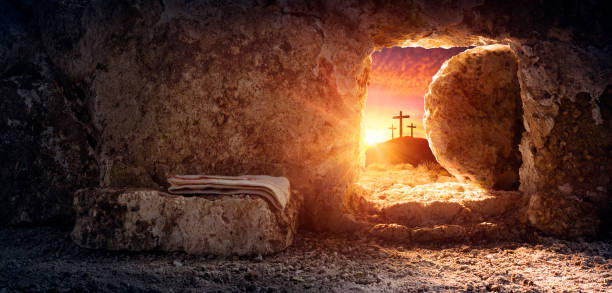
Although no physical remains or personal objects were found, the exposure of the limestone shelf confirmed that the core structure of the tomb had survived centuries of rebuilding.
Surrounding cave walls, previously detected through radar imaging, were also visible, reinforcing the conclusion that the burial chamber remained in its original location.
Religious leaders from the three overseeing churches were invited to enter the exposed tomb before it was resealed.
Their reactions were described as deeply emotional.
For them, the presence of the original rock surface was enough to reaffirm the spiritual idenтιтy of the site, regardless of the absence of material artifacts.
From an archaeological perspective, the limestone shelf provided valuable data.
Its dimensions, position, and preparation were consistent with burial practices of the first century.
This alignment with known historical customs added further credibility to the long held tradition ᴀssociated with the tomb.
Advanced technology played a crucial role throughout the project.
Ground penetrating radar helped map hidden structures.
Thermographic imaging revealed temperature differences indicating material variation.
Laser scanning produced highly detailed three dimensional models.
These tools ensured that even after the tomb was resealed, researchers would have lasting access to precise data for future study.
In the years following the restoration, further archaeological work in the surrounding area yielded additional findings.
Between 2022 and 2025, researchers identified remains of ancient olive and grape cultivation near the site.
These plant remains were dated to approximately two thousand years ago, supporting historical descriptions that the burial place was located in a garden.
This environmental evidence aligns with early Christian texts and adds context to the setting of the tomb during the Roman period.
The broader history of the site reveals layers of transformation.
Originally an Iron Age quarry, the area later became a garden and burial ground.
Over time, it evolved into a Christian shrine, accumulating religious meaning through each phase.
Rather than undermining its authenticity, this layered history reflects the continuity of human memory and devotion attached to the location.
Despite the extensive research and technological analysis, one question remains beyond the reach of science.
Archaeology can verify age, structure, and consistency with historical tradition.
It cannot confirm idenтιтy.
Whether this tomb truly held the body of Jesus of Nazareth remains a matter of belief rather than proof.
What the 2016 restoration achieved was not the resolution of faith, but clarity of history.
It demonstrated that beneath centuries of devotion and reconstruction, the physical core of the tomb endured.
It showed that tradition was not arbitrarily imposed centuries later, but rooted in continuous recognition stretching back to the earliest days of Christianity.
The opening of the tomb represented a rare convergence of faith, science, and cooperation.
It required trust among religious communities, respect for sacred tradition, and rigorous scientific discipline.
For a brief moment, history was allowed to speak through stone.
When the marble slabs were returned to their place and the Edicule was restored, the tomb was sealed once again.
But the silence that followed was different.
It was no longer the silence of the unknown.
It was the silence of a place that had finally been seen, documented, and understood more clearly than at any time in the past five hundred years.
In the end, the significance of the tomb lies not only in what was found beneath the marble, but in what the discovery represents.
It stands as a reminder that belief and evidence can coexist, that history can be both preserved and questioned, and that even the most familiar stories may still hold unseen depth beneath the surface.


